

The Helsinki Book Fair is one of the largest cultural events in the Nordic region, attracting more than 100,000 visitors and around 1,700 speakers across 17 stages each year. It is a major forum where writers, politicians, artists, and intellectuals from around the world discuss the most important issues of our time.
For the Ukrainian Association in Finland (UAF), participating in the event is no longer just a tradition but an important part of its cultural diplomacy and advocacy efforts on behalf of Ukraine in Northern Europe. This year marked the fourth time Ukraine was represented at the fair, taking place Oct. 22-25.
In an interview with the Ukrainian World Congress (UWC), UAF President Vasyl Hutsul discusses how the initiative began, the challenges Ukrainian books face abroad, and why cultural visibility is a tool for countering Russian propaganda.
From idea to ‘Ukrainian season’
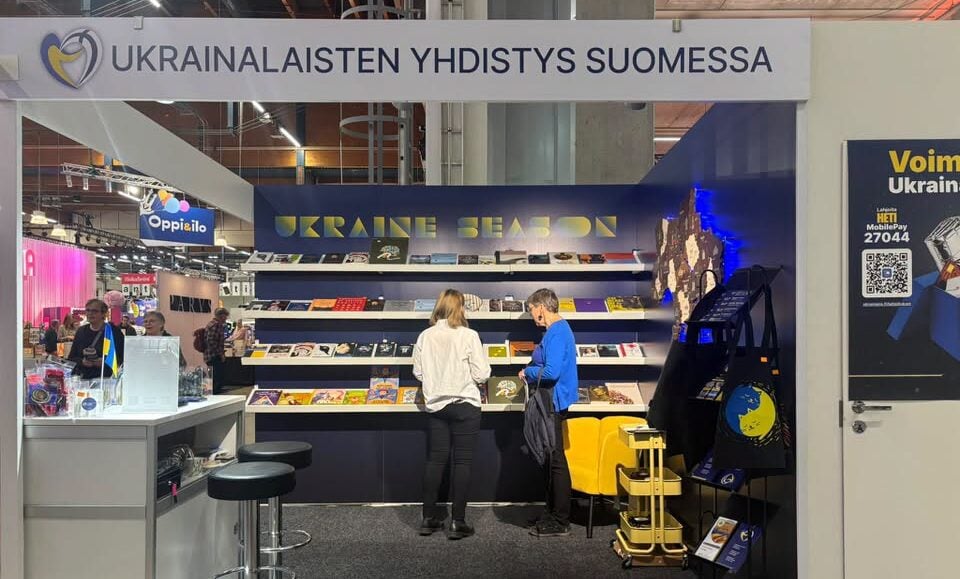
The introduction of a Ukrainian booth at the fair in 2023 was a natural step toward cultural diplomacy, Hutsul says. The booth serves several purposes: a small book exhibition, a meeting place, and a starting point for conversations about Ukraine. The UAF strives to select publications that will interest Finnish readers not only as accounts of the war but also as examples of high-quality contemporary literature, part of Ukraine’s cultural tradition, and distinctive artistic works.
“We do everything we can to establish a presence in the Finnish market, both in books and music. The idea of participating in the book fair came from our former cultural coordinator, Natalia Teramae. That was also when the idea of launching ‘Ukrainian Season’ emerged, and we have successfully carried it out for four consecutive years,” he adds.
However, representing Ukraine at the book fair is only one part of a broader program. The association’s main goal is to introduce Finnish readers to the best examples of contemporary Ukrainian literature and visual culture.
At the national booth, visitors can typically find high-quality illustrated books and photo albums, including publications by the Ukraїner project, as well as books by Ukrainian authors that have been translated into Finnish. In previous years, Finnish audiences have been introduced to works by Yevhenia Kuznietsova (The Ladder), Nastya Melnychenko (children’s literature), and Mariam Naiem (A Brief History of a Long War). Sofia Andrukhovych was a featured guest at one of the fairs. The association also recalls visits by Myroslav Laiuk, Artem Chekh, and Serhiy Zhadan, who visited Finland as far back as the late 2010s.
“Our goal is to make Ukrainian literature a fully established part of the Finnish book market. To achieve that, Ukrainian books need to be published in Finnish so that Finnish readers can read them and discover them for themselves,” Hutsul explains.
He acknowledges that Ukrainian literature currently has a much smaller presence in Finland than Finnish literature does in Ukraine. For the association, cultural diplomacy therefore means more than bringing books to an exhibition. It also means working to ensure that Ukrainian authors are translated, find publishers, and reach new readers.
Translators play an important role in this process. One of them is Eero Balk, a Finnish translator of Ukrainian literature whose extensive body of work has helped Ukrainian authors reach Finnish-speaking readers. In 2025, he received the Drahomán Prize for 2024 for his Finnish translation of Yevheniia Kuznietsova’s novel The Staircase.
Hutsul also mentions Yurko Zub, a translator of Finnish literature into Ukrainian who works to foster dialogue between the two languages. Among his major projects are translations of Carl Gustaf Mannerheim’s memoirs and Mika Waltari’s novel The Egyptian.
This exchange is important precisely because it works both ways, helping Finnish readers discover Ukraine while enabling Ukrainians to better understand Finland’s literary tradition.
Literature about war
This year, the UAF presented a rich cultural program at the fair and at related events.
At the fair itself, a panel discussion featured Victoria and Pavlo Matyusha, authors of the collection Letters of Love and War. The discussion was moderated by Lukas Stasevsky, a well-known Finnish-Ukrainian journalist with the Finnish public broadcaster Yle.
Another key event taking place away from the fairground will be a poetry reading and discussion with Ukrainian poet and prose writer Pavlo Matyusha. The event will be moderated by Nadiia Fedorova, with Finnish interpretation provided by Anita Koskinen-Vasylenko.
There will also be an online meeting with writer and serviceman Illarion Pavliuk, featuring a discussion on how war changes people and contemporary literature.
At the Ukrainian booth, translator Yurko Zub will speak about his new translation of The Egyptian, a classic of Finnish literature by Mika Waltari. He will also share the results of his extensive work on the first major Finnish-Ukrainian and Ukrainian-Finnish dictionary.
Behind the Ukrainian booth is a great deal of organizational work. The team prepares the books, sets up the space, staffs the booth, attends other discussions, and talks with visitors who want to learn more about Ukraine.
Hutsul says visitors often do more than browse the books; they also share their own family histories. For many Finns, the issue of territories currently occupied by Russia has a personal dimension. Their families, too, remember places lost through historical events and wars. This shared experience creates additional points of connection between Ukrainians and Finnish audiences.
The book fair cannot solve every problem related to Ukraine’s cultural visibility. However, it provides an opportunity to start conversations, find readers, establish professional connections, and gradually expand the presence of Ukrainian authors in Finland.
For the UAF, the work does not end on the final day of the exhibition. Its success is measured not only by the number of books sold or visitors who stop by the booth, but also by whether Ukrainian names become more familiar in Finland’s literary landscape, whether new translations are published, and whether Ukraine becomes better understood by people who previously knew little about it.
The fight for cultural visibility
For Hutsul, Ukraine’s presence at the book fair has another dimension: countering the longstanding dominance of Russian culture in Finland’s cultural landscape. He notes that Finnish readers have historically had access to a wide range of Russian literature, from the classics to contemporary authors. This presence developed over decades, particularly in the context of Finland’s postwar relations with the Soviet Union. Ukrainian literature, by contrast, has had to build its own recognition and overcome an uneven playing field
“One of our most serious challenges is ensuring a Ukrainian cultural presence. We try to bring books, showcase music, and tell people about our authors. But the most important thing is making Ukrainian literature available in Finnish,” he says.
The goal is not to replace one culture with another, but to ensure that Ukrainian culture finally receives the place it deserves in a cultural landscape where Russian books and authors have long been familiar to a broad audience. Ukrainian literature should be accessible in its own right, without having to explain over and over why it deserves attention, Hutsul emphasizes.
That is why it matters that books by Ukrainian authors are translated into Finnish, presented at public events, and become the subject of discussion. In this sense, the book fair is a tool for cultural advocacy, creating space for the Ukrainian voice in a setting where it may previously have been heard far less often.
Beyond literature, the UAF’s cultural work supports adult choirs, a children’s choir, and a children’s dance group, and organizes Ukrainian music concerts ranging from folk and contemporary music to classical performances. Special attention is given to events marking Ukraine’s Independence Day, the anniversary of the full-scale Russian invasion on Feb. 24, and Christmas classical music concerts. According to Hutsul, these performances have already become a tradition within the Ukrainian community in Finland.
All these initiatives share a common goal: to present Ukraine not only through the war and news coverage, but also through its literature, music, creativity, and people’s experiences. For Ukrainians living abroad, this is also a way to preserve their identity while building connections with the society in which they live.
Cover: AUF on Facebook