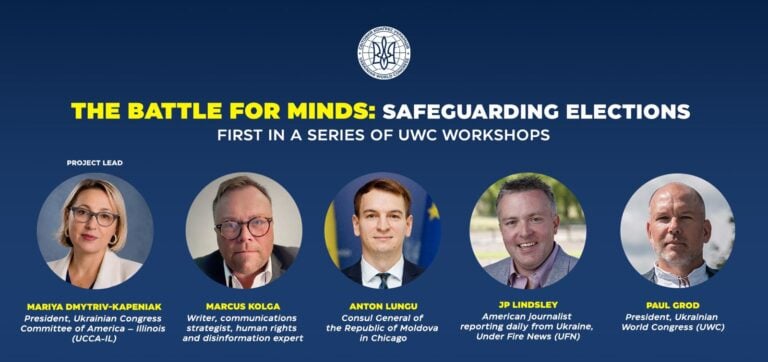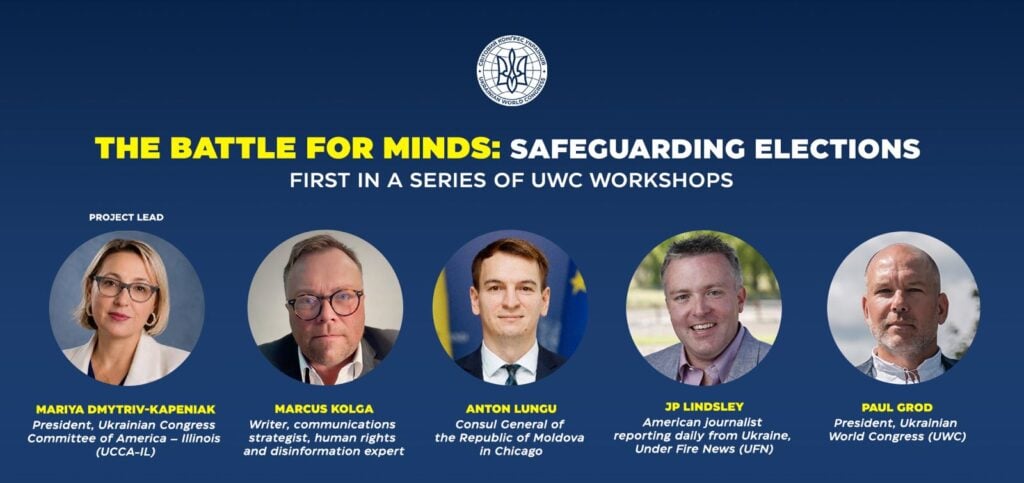


On Oct. 22, the Ukrainian World Congress (UWC) hosted an online webinar titled “Battle for Minds: Safeguarding Elections,” launching a new series of workshops and discussions aimed at countering today’s information threats. The initiative was launched following the UWC Global Ukrainian Summit in Bern in June.
As Russia systematically uses disinformation and election interference to undermine democracy, understanding these threats and developing effective tools to counter them is critical.
During the webinar, participants examined Russian interference in electoral processes and democratic institutions. Drawing on the experience of Moldova and other countries, experts discussed tactics for manipulating public opinion, undermining trust in elections, identifying disinformation, and countering foreign influence operations.
The panel brought together international and Ukrainian experts and officials, including Anton Lungu, Consul General of the Republic of Moldova in Chicago; Marcus Kolga, writer and expert on human rights and disinformation; J.P. Lindsay, an American journalist with Under Fire News (UFN); and Mariya Dmytriv-Kapeniak, project lead and head of the Ukrainian Congress Committee of America (UCCA) Illinois Division.
In his opening remarks, UWC President Paul Grod paid tribute to the late Pavlo Sadokha, UWC Vice President for Southern Europe, who first proposed the initiative. Grod emphasized that Sadokha’s dedication to justice and Ukraine’s independence and sovereignty remains an example for Ukrainian communities around the world.
“Pavlo understood that disinformation is a weapon Russia continues to use against the Ukrainian people and every democracy it sees as a threat. He wanted our community to recognize this weapon and fight back. This series is part of his legacy,” Grod said.
Marcus Kolga stressed the importance of preparing society for information attacks before they occur. He cited allegations announced by the U.S. Department of Justice in September 2024, according to which two employees of Russian state broadcaster RT allegedly directed nearly $10 million to fund a North American media operation featuring American influencers.
“It’s important not only to correct false information, but also to prepare people before they encounter it by explaining manipulation tactics in advance and providing accurate, verified information,” Kolga said.
Drawing on Moldova’s 2025 election experience, Anton Lungu emphasized the need to investigate networks coordinating disinformation campaigns, communicate quickly with the public, and protect electoral and digital infrastructure.
“When institutions remain silent, misleading narratives can fill the information vacuum,” he warned.
J.P. Lindsay emphasized that countering Russian influence requires a strategic approach and an understanding of people’s motivations.
“Russia uses the concept of reflexive control to manipulate our emotions and influence our decisions. We must be just as strategic in our response while remaining true to our own values,” he added.
Mariya Dmytriv-Kapeniak noted that the initiative will include not only webinars but also practical tools to help people find and verify information.
Announcements about upcoming events will be shared on UWC’s social media channels. Updates are also available through the organization’s weekly newsletter.