



Alaska has always had a reputation as a harsh, remote, and somewhat mysterious place, where the main challenge for a person is simply surviving amid untamed nature, a difficult northern climate, and geographic isolation.
For most people, the northernmost US state is associated with majestic mountains, cold ocean winds, the Gold Rush, and wild taiga. Yet for Ukrainians who arrived here in different historical eras, this distant land became not only a place where their resilience was tested, but also a setting for a complex struggle – often invisible to the outside world – to preserve their national identity.
The history of the Ukrainian presence in Alaska is full of deep paradoxes – from the first settlers at the beginning of the 20th century to the new wave of refugees who arrived here following Russia’s full-scale invasion in 2022.
Mykola Taran, a Ukrainian activist, ultramarathon runner, five-time Ukrainian running record holder, ambassador for the UNITED24 presidential initiative, and organizer of charity runs in Europe and the United States, who has been living in Alaska since last year, speaks openly about the state of the community, deep-rooted problems of assimilation, the lack of national institutions, and cultural and religious pressure.
‘It doesn’t really exist’
In the public consciousness and school textbooks, there is traditionally an image of strong and close-knit Ukrainian communities abroad – in Canada, Chicago, or New York – where traditions have been nurtured for decades, Saturday schools have been established, and the Ukrainian language preserved.
In Alaska, however, the reality turned out to be completely different, Mykola says. The first thing a Ukrainian who is conscious of their national identity encounters upon arriving in the state is the complete absence of an established Ukrainian community that would advocate for its national interests, he argues.
“I want people to know about the real problems facing the Ukrainian diaspora that are often left unspoken. Although it is difficult for Ukrainians abroad to defend their language and culture, the diaspora is precisely what helps preserve them,” Mykola Taran says.
Alaska is attractive because of its incredible natural beauty, which strongly resembles western Ukraine – with the same majestic mountains, forests, and sense of tranquility, he adds. Despite the harsh climate, potatoes grow well here, which also gives the region a certain resemblance to Ukraine.
Residents of Anchorage are significantly different from people on the East Coast of the United States. In New York, if you ask someone about their life, they will immediately start talking about work and career. In Alaska, people will tell you about their hobbies – mountain biking, skiing, running, or hiking. Yet behind this outward calm and beauty lies a complete vacuum in Ukrainian civic life, Mykola argues.
 The first pages of Ukrainian history in Alaska began to be written at the beginning of the 20th century. There is little archival information about the first Ukrainians, but the local Ukrainian environment is associated with a priest who was fleeing persecution by the Russian Empire, Mykola says.
“He established the first English- and Russian-language publications, including, eventually, the Svoboda newspaper, where Ukrainian issues began to be raised, although they remained superficial and did not contribute to preserving the language,” he adds.
At the same time, Ukrainian Cossacks and other forces recruited by the empire made their way to Alaska, thousands of whom never returned home. The first settlers came predominantly from eastern regions of Ukraine that were under strong imperial influence. They were drawn by the Gold Rush, mining jobs, and the opportunity to acquire land, the activist says.
“Without a developed national consciousness, they focused on survival and gradually switched to Russian,” Mykola adds.
A new wave
The full-scale war in 2022 brought a new wave of Ukrainians to Alaska – more than a thousand people, according to estimates from local organizations. However, just like the first settlers a century ago, many newcomers initially focused primarily on establishing their lives: finding housing and work, dealing with paperwork, and helping their children adapt. Questions of preserving the Ukrainian language and culture often remained secondary, Mykola says.
According to him, some Ukrainians still do not consider the language issue important and justify the use of Russian by pointing to linguistic habits or examples from other countries.
“Some people still try to defend Russian instead of supporting Ukrainian. There is a widespread belief that the whole world speaks Russian, but that is a myth,” he says.
One of the main centers providing assistance to Ukrainians in Alaska has been the Baptist New Chance Church in Anchorage. In the absence of Ukrainian diplomatic and cultural institutions, the organization helps newcomers settle in – meeting them at the airport, providing temporary housing and food, assisting with applications for aid through the Uniting for Ukraine program, and helping them find work. Through these efforts, the church has established cooperation with local authorities.
At the same time, the church’s language policy remains a subject of discussion among Ukrainians. The organization operates in Russian, which, in Mykola’s view, may influence the linguistic and cultural environment surrounding newcomers.
“The church helps Ukrainians, but at the same time, people find themselves in a Russian-speaking environment. In my opinion, it is important that, alongside humanitarian assistance, there should also be initiatives that support the Ukrainian language and culture,” he explains.
Taran also points to the absence, in his words, of regular Ukrainian-language cultural programs, children’s camps, or language courses at the church. He believes that for Ukrainians who arrived after the beginning of the full-scale war, it is important to have the opportunity not only to adapt to their new lives but also to preserve their own cultural identity.
According to Taran, similar language challenges can be seen in Delta Junction, a small town approximately seven hours from Anchorage. A significant number of Ukrainians have moved there, and despite their noticeable presence in the community, the everyday environment remains predominantly Russian-speaking.
Dependence on religious communities and local Russian-speaking employers has created an atmosphere of fear and passivity among Alaska’s Ukrainians, Mykola argues. This became particularly evident during important social and political events.
When protests took place in Alaska or important commemorative dates came around – the anniversaries of the full-scale invasion, Ukraine’s Independence Day, Flag Day, or commemorations of the victims of the Holodomor – church communities and the largest local social media groups completely ignored these events, he adds.
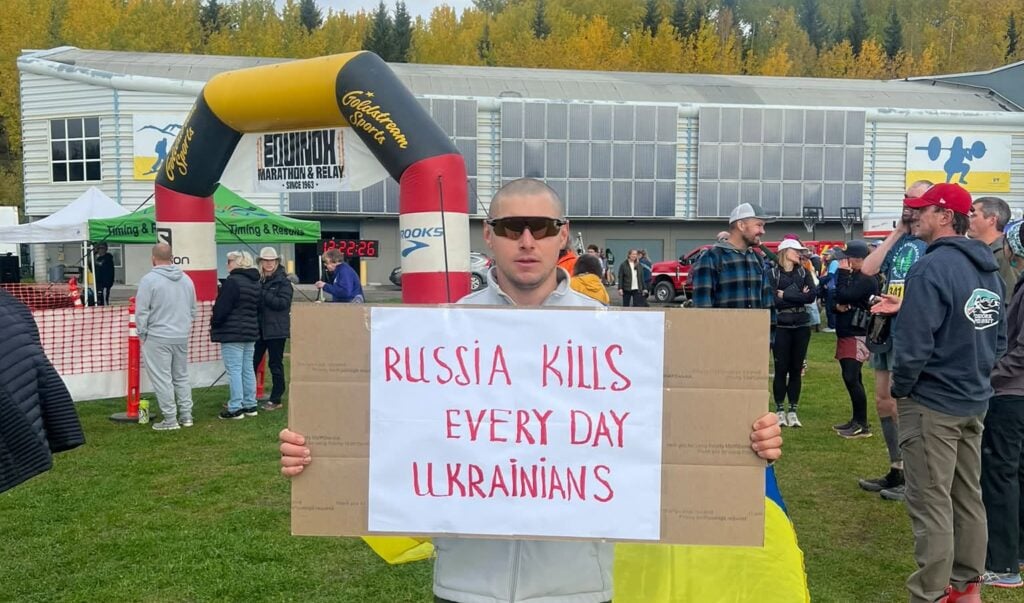
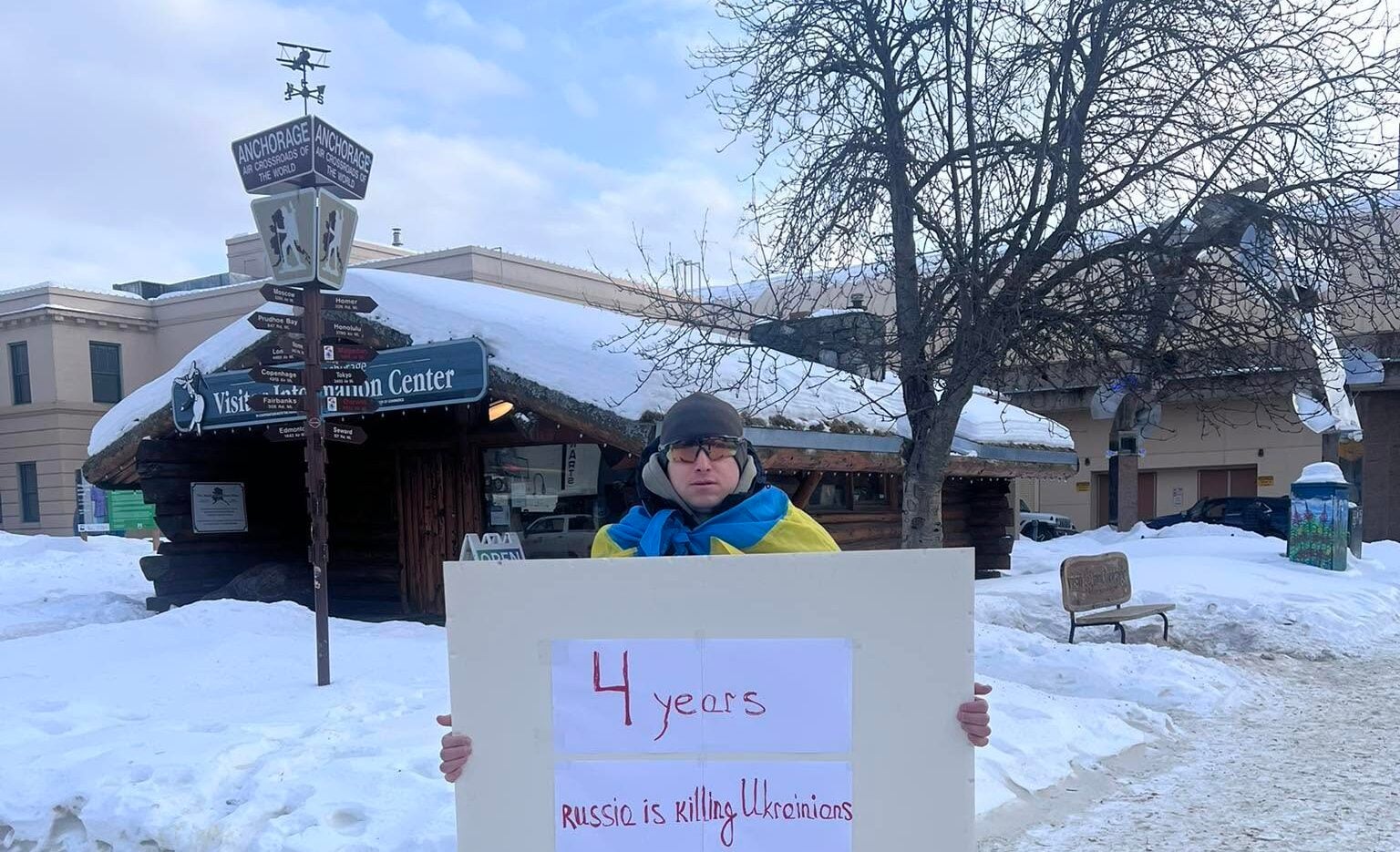
“There was almost no mention of or events for Ukraine’s Independence Day. On the anniversary of the war, I was the only one who went downtown with a sign and called on others to join me, but no one came. At the same time, Americans came up to me and showed their support,” Mykola recalls.
Moreover, misinformation and intimidation are spreading in some local communities, he adds. People are discouraged from participating in rallies, including through threats of problems with their documents, while expressing a Ukrainian position is sometimes portrayed as “inciting hatred.”
Running alone against the current
Finding himself in such an environment, Mykola decided not to adapt to the circumstances. Completely independent of local religious communities and working with an American team, he began his own educational and activist mission.
Mykola has focused his activities on three areas: sports diplomacy – participating in races with the Ukrainian flag and raising funds for the Armed Forces of Ukraine; developing a Ukrainian-language community through the “Ukrainians in Alaska” Facebook group; and public actions and communication with American media and authorities.
“I chose my own path: I created a group where the Ukrainian language matters, and through sports and the flag, I remind Americans about the war,” Mykola explains.
In his view, the history of Ukrainians in Alaska demonstrates the importance of supporting language, culture, and national identity abroad.
To change the situation, Mykola believes several steps are necessary: strengthening Ukraine’s institutional and diplomatic presence in Alaska; informing local authorities and donors about the activities of organizations that help Ukrainians; creating Ukrainian-language educational opportunities for children; and supporting local activists and independent Ukrainian initiatives.
The struggle for a Ukrainian Alaska continues, and it demonstrates that even one conscious individual in a harsh northern land can challenge the system of assimilation and loudly remind the world what Ukraine is and what it is fighting for.
The views and assessments presented in this text are the personal position of Mykola Taran and reflect his experience and perspective on the situation within Alaska’s Ukrainian community. The text is intended to draw attention to the issues he has raised and does not claim to provide an exhaustive account of all viewpoints and circumstances.
Latest news
 #GlobalAdvocacy
Russia seizes foreign businesses: Turning Kremlin blackmail into advocacy tool
 #LocalAction
Russia’s nickel in Finland: Ukrainians demand closure of sanctions loophole
 #CallToAction