



A conflict over historical memory in May of this year marked the beginning of a “perfect storm” in Ukrainian-Polish relations. The crisis between the two countries escalated beyond ordinary diplomatic misunderstandings into deep, systemic political tension.
At the same time, Kyiv and Warsaw recognize their fundamental mutual dependence – Poland currently serves as the main logistical hub for western arms supplies to Ukraine, while the Ukrainian army acts as a shield for Poland itself against potential Russian aggression or hybrid attacks.
So while high-profile political statements echo, day-to-day work continues – the two sides are negotiating practical matters and maintaining cooperation, primarily in defense. One of the mediators in the dialogue between the two nations is the Ukrainian community in Poland.
The Association of Ukrainians in Poland (AUP) has been active for over 35 years, working with the Polish authorities throughout this entire period. This long-term work keeps public attention focused on the Ukrainian issue and helps sustain dialogue even when political relations sour.
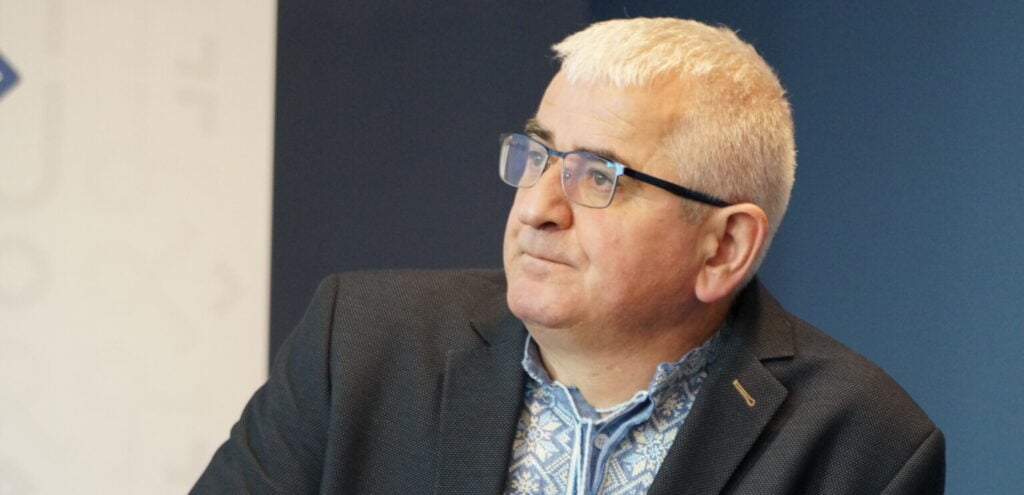
How this is achieved was explained by the head of the AUP, Miroslaw Skorka, in an interview for the Ukrainian World Congress (UWC).
Dialogue, but no breakthrough
Over the last few months, nothing has fundamentally changed between Kyiv and Warsaw, says Skorka. The sides maintain official contact and resolve ongoing issues at the governmental level, but there are currently no truly high-profile decisions or large-scale joint projects.
“Poland has noticeably reduced the amount of assistance to Ukraine – both at the state level and at the level of civil society. Right now in Polish society, it is becoming increasingly difficult to convince people of the need to support Ukrainians, especially those who remain inside Ukraine,” Skorka adds.
Furthermore, long-standing friction points remain in the economy. Poland sells more goods to Ukraine than it buys, yet it continues to block imports of Ukrainian grain. On the other hand, the issue of steel exports has lost its previous intensity, as production in Ukraine itself has dropped significantly.
For Ukraine, maintaining the logistical and military hub in Rzeszów is critical. Understanding this, Kyiv avoids rash moves and confrontations over other matters, stresses the head of the AUP.
At the same time, discussions regarding the presence of Ukrainian migrants have recently intensified in Polish political discourse. In particular, statements were made by the opposition party “Law and Justice,” notably from Jarosław Kaczyński, regarding the possibility of deporting military-age men back to Ukraine.
“Although this was publicly explained as a need to strengthen the recruitment potential of the Armed Forces of Ukraine, in reality, it is an attempt to pounce on the far-right electorate, which believes there are too many Ukrainians in Poland. None of Poland’s leading political forces are in a rush to completely abandon such rhetoric right now, and they are testing voter sentiment,” Skorka explains.
Kyiv’s ‘hard realism’
Despite the difficult backdrop, Ukraine consistently fulfills its commitments in the sensitive sphere of history, the head of the AUP continues. Search expeditions are taking place in Volhynia, and work has been conducted in Lviv, particularly at the cemetery of Polish soldiers who died in September 1939.
“Of course, one might ask why so much attention needs to be paid to this during a war. But I understand that such steps matter for reducing anti-Ukrainian sentiment in Polish society,” says Skorka.
It is also important that the Ukrainian authorities generally treat such work calmly, agreeing to search expeditions and exhumations.
Another issue, he adds, is the lack of desire on the Ukrainian side to engage in open historical disputes or public polemics with the Polish government, the opposition, or President Karol Nawrocki.
“I think that Ukrainian policy here is based on a rather firm understanding of realities and its own interests. The reality is that it will be difficult to conduct a normal dialogue with certain political forces. And Ukraine’s interest is to withstand this war, not lose it, and secure the opportunity for victory,” says Skorka.
To achieve this, Ukraine needs cooperation with Poland, he adds. And if full-fledged cooperation is lacking, then at the very least, it is important that Poland does not impede assistance to Ukraine from other nations.
“Therefore, a certain hard realism is very noticeable right now. We do not see any particularly prominent steps at the level of presidents, prime ministers, or ministers. But at the same time, Ukraine is trying to preserve what is critically important to it.”
Working regardless of politics
The AUP emphasizes that, after more than 35 years of work, it has become accustomed to operating independently of political relations between Kyiv and Warsaw. The experience of different Polish governments, Skorka says, has demonstrated that the predictability of Polish policy cannot always be counted on.
Therefore, the organization continues to focus on protecting the rights of the Ukrainian minority, working with local communities, organizing cultural events, and maintaining contacts with Polish institutions. At the same time, hate speech targeting Ukrainians and disinformation are increasingly being identified as major problems.
Skorka says disinformation has long been present in Poland’s information space, but during the war it has become another tool of influence. Russian information operations are of particular concern, as is the fact that narratives created outside Poland can be adopted by Polish political forces.
“Information that originates outside Poland can penetrate Polish political discourse and be used to create and spread anti-Ukrainian narratives,” he says.
At the same time, the head of the AUP emphasizes that the Ukrainian community must actively participate in Poland’s public dialogue. According to him, there are many people in Poland who are willing to better understand Ukraine, learn about Ukrainian culture, and support cooperation.
“The participation of the Ukrainian community in this process is crucial. It makes it possible to shape an objective view of Ukraine, counter anti-Ukrainian forces, and build long-term partnership and cooperation at the level of civil society,” Skorka says.
Cover: Nashe Slovo
Latest news
 #GlobalAdvocacy