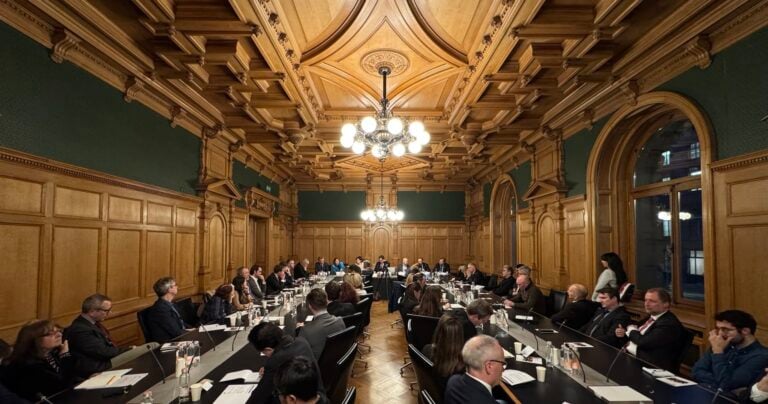


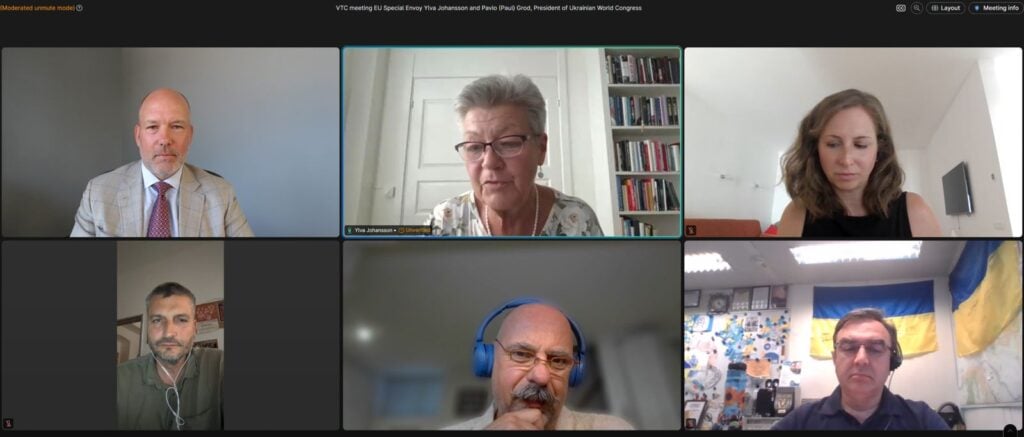


A delegation of the Ukrainian World Congress (UWC), led by President Paul Grod, met on August 4 with Ylva Johansson, the European Union’s Special Envoy for Ukrainians in the EU, to discuss the future of the more than four million Ukrainians living in Europe under temporary protection following Russia’s full-scale invasion of Ukraine.
The UWC delegation included Bohdan Rajcinec, President of the European Congress of Ukrainians; Rostyslav Sukennyk, President of the Confederation of Ukrainian Organizations in Germany; Roman Zyla, UWC Executive Director; Andriy Shevchenko, Special Advisor to the UWC; and Mariia Balanovych, UWC Operations Coordinator in Ukraine.
President Grod opened the meeting by thanking Special Envoy Johansson for her role in the recently adopted extension of EU temporary protection to March 2028, and for her leadership in establishing the Diaspora Alliance for the Recovery of Ukraine, launched at the Ukraine Recovery Conference in Rome.
Key issues discussed
- The road beyond March 2028. Both sides agreed that displaced Ukrainians need predictability and should not put their lives on hold. Discussion focused on supporting a gradual, well-communicated transition from temporary protection into durable legal statuses that preserve the ability to return to Ukraine, and on encouraging Member States to adapt national residence rules to the circumstances of Ukrainians already living and working in Europe. The Special Envoy affirmed that no Ukrainian will be forced back to Ukraine and that transitioning to a durable status does not close the door to returning home.
- The UWC’s three principles. President Grod presented the consolidated position of the global Ukrainian community: genuine choice for every Ukrainian between a legal path home and a legal path to build a life abroad; one unified European approach rather than 27 separate national policies; and integration without assimilation, so that Ukrainians integrate fully into host societies while keeping their language, identity, and ties to Ukraine.
- Unity Hubs. The delegation highlighted the role of the organized Ukrainian community in delivering Ukraine’s Unity Hubs initiative, including the launch of the Unity Hub in Berlin led by the Confederation of Ukrainian Organizations in Germany, and offered to scale this model across Europe in coordination with Ukraine’s government.
- Jobs and voluntary return. Participants discussed linking vacancies in Ukraine with Ukrainians in EU Member States, flexible and circular forms of engagement with Ukraine, and the upcoming voluntary return and recovery pilot, which the UWC offered to support with its community networks.
- Countering disinformation and rising hostility. The delegation raised growing anti-Ukrainian sentiment in several Member States and the intensifying Russian disinformation campaigns targeting displaced Ukrainians. Both sides agreed on the need for trusted, credible communication with Ukrainian communities and closer cooperation with EU institutions working on strategic communication.
- Ukrainians as a bridge to EU membership. The discussion underscored that millions of Ukrainians living in the EU today represent an investment in the future: a human bridge supporting Ukraine’s path to European Union membership and its eventual reconstruction.
Key outcomes and next steps
- Regular structured dialogue. The Special Envoy and the UWC agreed to hold recurring focused meetings, each dedicated to one or two priority topics, coordinated with the European Commission’s Directorate-General for Migration and Home Affairs, with future sessions to include Ukrainian community leaders from across EU Member States.
- A joint two-track initiative. The parties agreed to develop a common framework combining research and polling to understand the needs and intentions of displaced Ukrainians, and a coordinated communication effort, through channels the community trusts, to help Ukrainians make informed decisions about durable legal status. Possible EU funding avenues will be explored through the Commission.
- Cooperation on voluntary return. The UWC will support the voluntary return and recovery pilot with its knowledge and community networks, with emphasis on strengthening local communities in Ukraine and avoiding tensions between those who left and those who stayed.
- Dedicated session on disinformation. A future meeting will focus on Russian disinformation targeting displaced Ukrainians, with the participation of relevant EU strategic communication experts.
- Written follow-up. The UWC will provide the Special Envoy’s office with its position paper on long-term protection and concrete proposals for the agreed areas of collaboration.
“The decisions of the coming years will shape the lives of over four million people and the future of Ukraine itself. Special Envoy Johansson has been a true partner of the Ukrainian people, and today we agreed to turn that partnership into a standing framework: regular dialogue, joint research, and trusted communication with our communities. Every Ukrainian deserves a genuine choice, a legal path home or a legal path to build a life abroad, made freely and with dignity,” said Paul Grod, President of the Ukrainian World Congress.
“These amazing Ukrainian people are a big investment in the future, for Ukraine and for the European Union. We have to keep supporting Ukraine in the war while also preparing for life and for the rebuild, and it is great to have the Ukrainian World Congress as part of Team Ukraine,” said Ylva Johansson, EU Special Envoy for Ukrainians in the EU.
Latest news
 #UWC news
UWC President calls for support for Ukrainian service members on Defenders Day
 #LocalAction
Between white snow and the shadow of assimilation: Ukrainian life in faraway Alaska
 #GlobalAdvocacy