



Russia’s presence in South America is not a new challenge but a deeply rooted historical and geopolitical reality. In Argentina, Kremlin propaganda has spent decades building networks of influence through culture, education and political ties. Business has played a particularly important role in this process.
To discuss how the Ukrainian community is countering these influences, why much of Latin America’s academic environment leans to the left, and why cultural diplomacy remains perhaps the only truly effective way to engage local audiences, we spoke with Jorge Danylyshyn, UWC Regional Vice President for South America and President of the Prosvita Ukrainian Cultural Society.
The anatomy of Russian influence
Russian influence in Latin America, particularly in Argentina, dates back to diplomatic relations established in the early 20th century. At the time, membership in or ties to the Russian imperial aristocracy carried considerable prestige in Argentina’s conservative ruling circles, as the country was then a young and economically powerful nation.
After the fall of the Russian monarchy, many aristocrats sought refuge in Latin America, while senior Russian military officers organized armies in the region for conflicts such as the Chaco War.
At that time, the Russian Orthodox Church – the only Orthodox church in the region – served as the main unifying force, bringing together Orthodox Christians of various backgrounds, including Russians, Greeks, Bulgarians, Romanians, Belarusians and Syrians. To some extent, it became the institution that united these communities. Ukrainian Orthodox and Greek Catholic churches had not yet been established in the region.
Another factor that should not be overlooked is that the Ukrainian community itself was initially divided between separatist and pro-Russian groups. Although this division has diminished over time, it has not disappeared. Pro-Russian organizations still exist and, for example, continue to hold Victory Day marches. These demonstrations are marginal, but ignoring them would be unwise because they still influence society and politicians, who are generally reluctant to take clear positions on conflicts.
 The most powerful platform for Russian influence today is Argentina’s public university system, particularly the humanities faculties. Intellectual circles in the country have traditionally leaned strongly to the left, largely shaped by a long history of anti-American sentiment. Universities, especially humanities departments, remain the primary channel through which left-wing groups influence students, reinforcing anti-British and anti-American narratives that resonate throughout much of the region.
Ukraine’s close ties with the US and the United Kingdom also complicate perceptions. Argentina’s historical memory includes two British invasions and the Falklands War, while Britain’s colonial stance over the islands remains a sensitive issue despite UN resolutions.
The Russian Embassy and the Russian House (Casa Rusa) systematically build on these sentiments, promoting Kremlin narratives wherever skepticism toward the United States and Western Europe already exists. Because Ukraine is now widely viewed through the lens of its alliance with the West, many on Argentina’s political left automatically extend their negative attitudes toward the West to Ukraine.
The demographic situation has also added to the challenge. In recent years, around 130,000 Russians have arrived in Argentina, many with significant financial resources that allow them to maintain a highly visible public presence. This is reinforced by an extensive media network, including radio stations that promote “the greatness of Russian culture” while avoiding any discussion of the war, Danylyshyn says.
Political caution and “balance” in the media
As for Argentina’s news media, after the surge of interest during the first days of Russia’s full-scale invasion, Ukraine quickly disappeared from the front pages. Domestic issues and football – which accounts for more than half of television airtime – once again took center stage.
When the war is covered, journalists often rely on the principle of presenting “both sides.” Television channels frequently present Ukrainian and Russian narratives simultaneously, creating a false sense of objectivity. For the average Argentine, who is far removed from the European context, it becomes difficult to understand who is responsible and where the truth lies. In that fog of uncertainty, the Kremlin gains an advantage.
At the same time, ordinary Argentines generally do not sympathize with Russia or its aggression. Rather, they struggle to grasp the scale of the tragedy and have grown weary of a war taking place more than 8,000 miles away.
According to the UWC vice president, after President Javier Milei took office, Buenos Aires’ official foreign policy shifted decisively toward Washington. Although his administration was strongly supportive of Ukraine from the outset, Argentina’s position on Ukraine today is largely aligned with that of the US.
At the same time, the Ukrainian community continues to encounter caution among mid-level politicians and officials, many of whom prefer to avoid “creating problems” for themselves. Argentine politicians are generous with promises and friendly gestures, but when it comes to concrete action, progress often stalls.
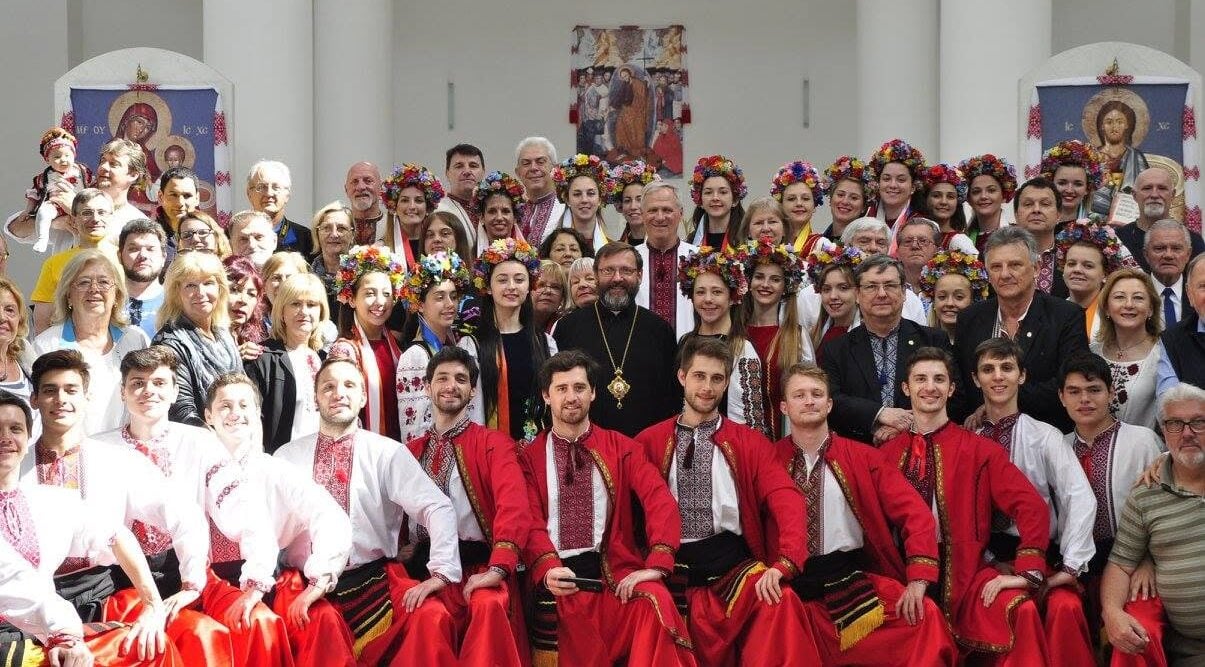
Similar pressure is felt at the local level. Every year, for example, a Ukrainian dance ensemble closes the large Oktoberfest festival in Córdoba Province before an audience of around 30,000 people. When the performers conclude by carrying a large banner reading, “For a sovereign, united, independent and whole Ukrainian state,” the city’s mayor immediately receives angry calls from the Russian Embassy demanding that such “political performances” be banned.
“Fortunately, this particular official respects the Ukrainian community and does not give in to pressure. But most officials in the country prefer to avoid situations like this altogether, just to be safe,” Danylyshyn says.
Culture as the strongest weapon
Despite a vast imbalance in resources, Argentina’s Ukrainian community has held its ground for more than a century. Its greatest achievement, Danylyshyn says, has been convincing Argentines that Ukraine is not part of Russia. After Ukraine declared independence, people from Eastern Europe were commonly referred to simply as “Russians.” Today, Argentine society increasingly understands the distinction.
The community’s main tool for advocacy and countering Russian myths is high-quality cultural diplomacy.
“People in Ukraine do not always fully appreciate the enormous impact that culture has within diaspora communities. Russians understood this long ago. For years they have brought their finest classical ensembles to the world’s leading theaters, investing enormous amounts of state funding that may never pay off commercially but works perfectly in shaping Russia’s image,” the UWC vice president says.
 “To counter this, Ukrainians must showcase the scale of our own culture by bringing exhibitions by artists such as Ivan Marchuk, performances by the Virsky Ukrainian National Folk Dance Ensemble or the Ukrainian Bandurist Chorus. We need to demonstrate that Ukrainian culture is unique and has nothing in common with Russian culture. The key principle is to step outside our own comfort zone. We should be selling varenyky beyond our own community, not only within it,” he adds.
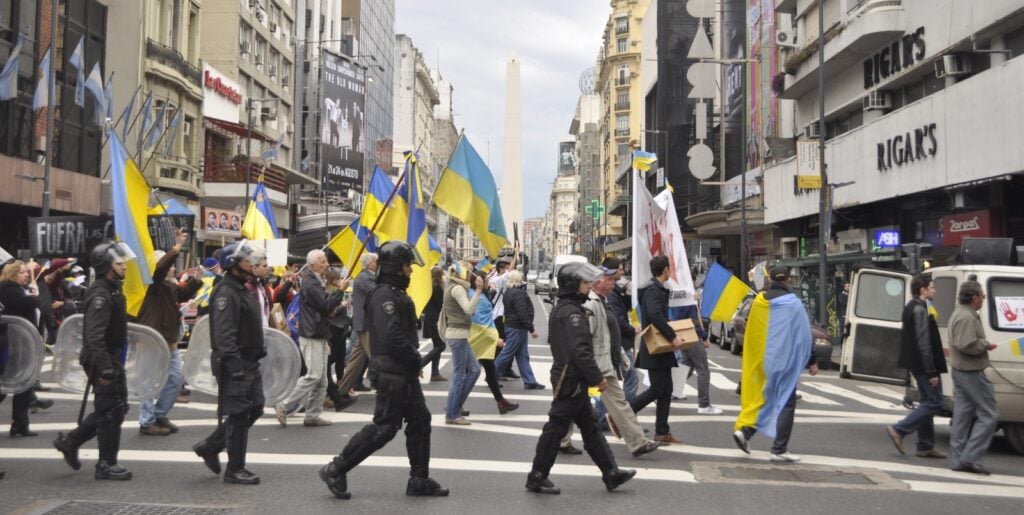
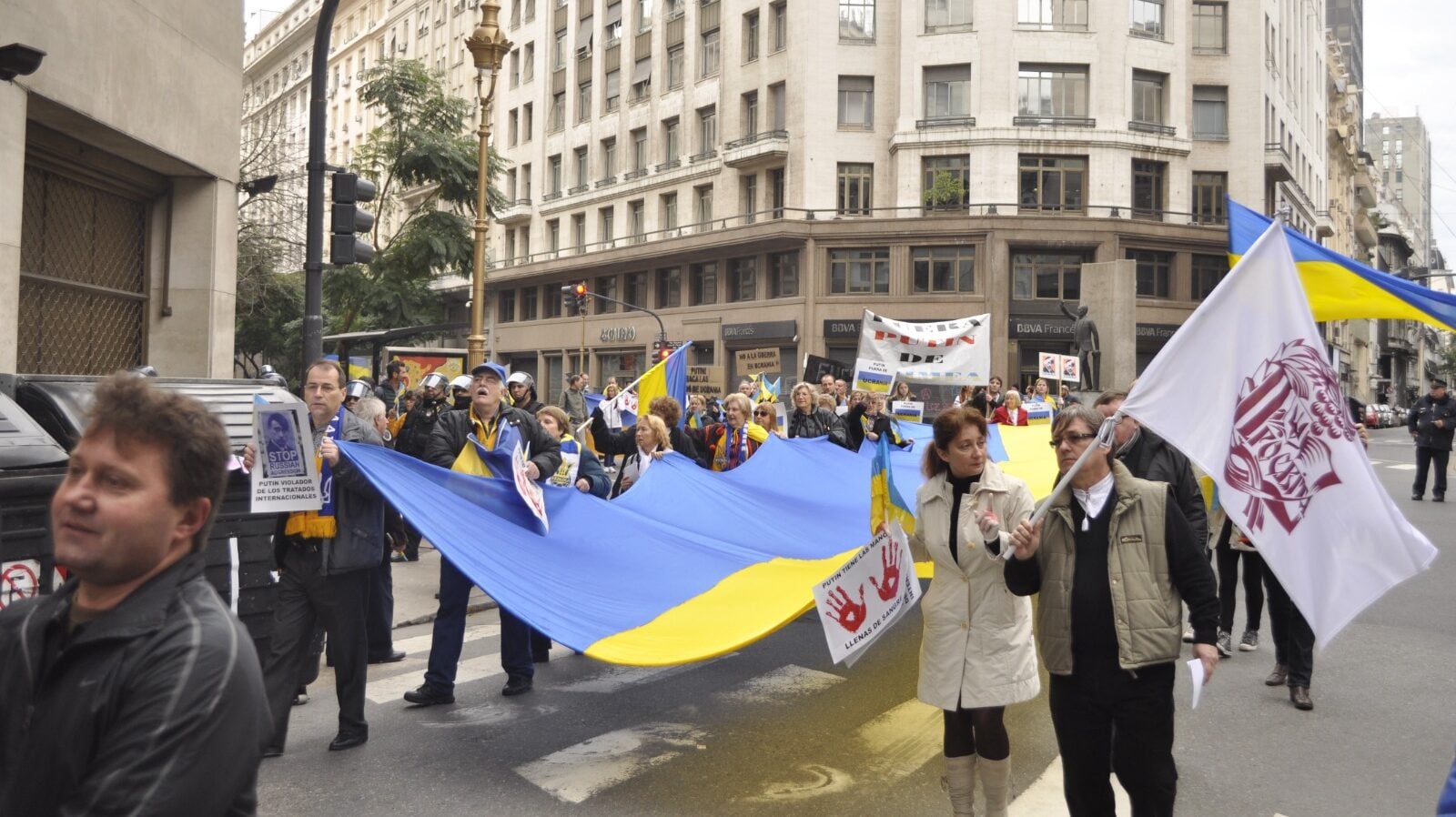
One of the community’s most notable successes came during Vladimir Putin’s visit to Argentina. The Russian president had been scheduled to lay flowers at a monument to an Argentine national hero, but the Ukrainian community organized such a large and vocal demonstration that the official ceremony – including a planned appearance with children representing Russia’s so-called “brotherly nations” – was canceled.
Another example of successful public diplomacy was the publication of a book about the Holodomor funded by the Buenos Aires city government. Thanks to the persistence of Prosvita representatives, the city’s human rights secretary agreed to finance the publication of Ukrainian materials translated into Spanish. Today, the book forms part of Argentina’s official trilogy on the genocides of the 20th century, alongside works on the Holocaust and the Armenian Genocide.
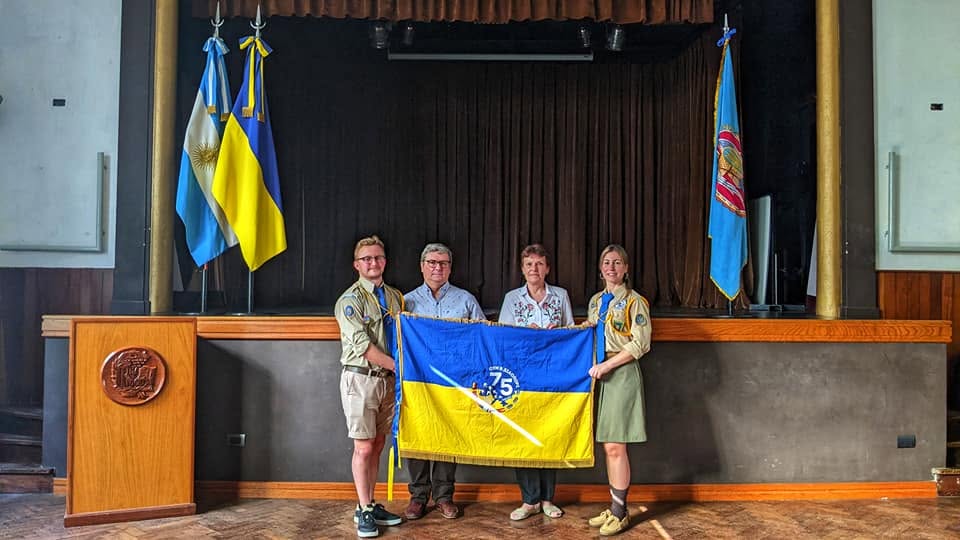
Danylyshyn considers the community’s greatest internal achievement to be the renewed interest in Ukrainian heritage among descendants of immigrants, a process accelerated by Russia’s full-scale invasion. People who had long ignored their roots – including members of the Jewish community who had previously identified themselves as “Russian” – are now coming to Prosvita to reconnect with their Ukrainian heritage.
Before the COVID-19 pandemic, the community’s Saturday school had around 40 students. Today, more than 180 people, including adults, participate in its online courses.
“At a terrible and very high cost, Ukrainians in Argentina have finally come to fully recognize themselves as Ukrainians,” Danylyshyn says.
Advocacy is a marathon
The head of Argentina’s Prosvita Society says there is no universal formula that works everywhere. Every country has its own unique political realities, social dynamics and public attitudes. Latin America is no exception.
Success requires learning to think in Latin American terms. It is impossible to simply transplant a European cultural or political program and expect it to have the same impact in South America. Local audiences respond to large-scale, accessible and emotionally engaging formats.
Advocacy in countries like Argentina is not a sprint but a marathon. “Our work cannot be limited to a single film screening or exhibition. We need a constant, daily presence in the information space,” Danylyshyn says.
 Building coalitions is equally important. Ukrainian organizations in Argentina achieve greater impact when they work alongside active Polish, Lithuanian and Latvian communities that share anti-colonial values and help strengthen public demonstrations.
Finally, if Ukraine is to compete with Russia’s well-funded propaganda machine, it must maintain a strong and active diplomatic presence while making sustained government investments in large-scale cultural projects and Spanish-language translations of historical literature.
Only long-term, systematic work combined with a deep understanding of the region’s mentality will ultimately shift the balance in Ukraine’s favor, Danylyshyn emphasizes.
Latest news
 #LocalAction
Kyiv, Warsaw, and Russian threat: How Ukrainians in Poland preserve dialogue
 #CallToAction