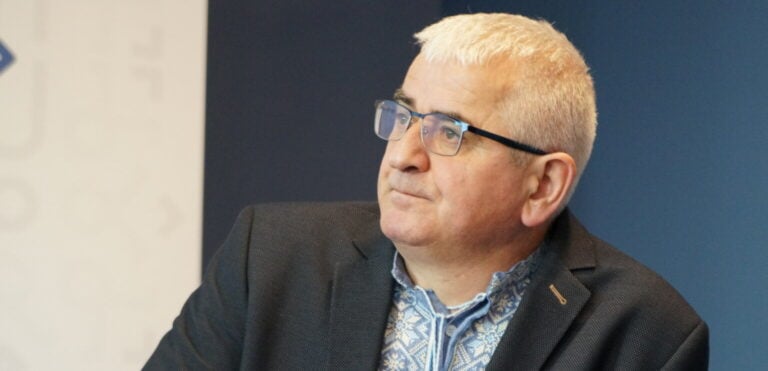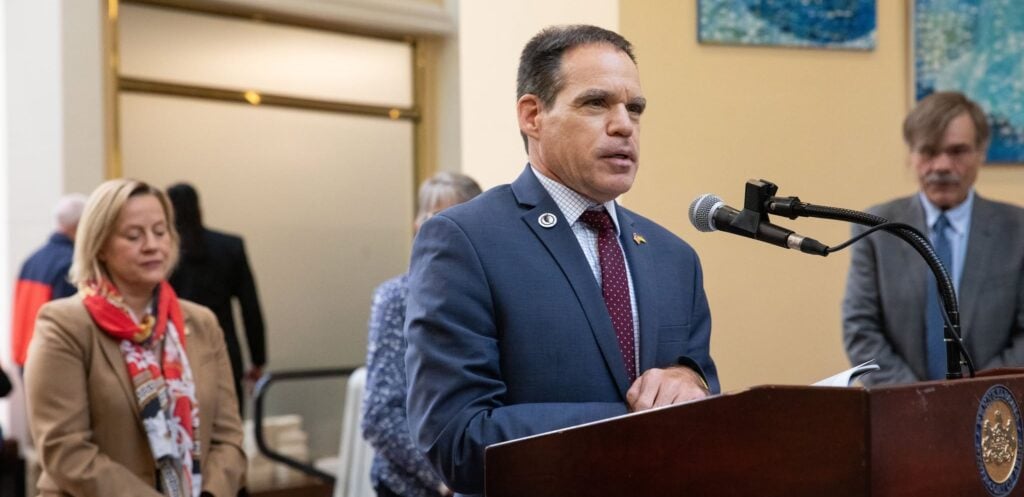


About the author: Michael Sawkiw, President of the Ukrainian Congress Committee of America (UCCA) and Director of its Washington, DC bureau – the Ukrainian National Information Service (UNIS), Chair of the Ukrainian World Congress (UWC) Foreign Policy Council, and recipient of the Order of Merit II degree.
Source: Ukrainska Pravda
For decades, the Ukrainian community in the U.S. has been working to ensure that relations between Ukraine and the U.S. remain strong and that Ukraine has reliable partners in Washington.
The Ukrainian Congress Committee of America (UCCA), a nonpartisan organization of Ukrainian Americans, has represented the community’s interests since 1940. Our position does not depend on which party is in power; our mission is to defend Ukraine’s interests. In our work and communications, we consistently explain to the American public that supporting Ukrainian sovereignty is important for America itself.
One focus of our advocacy is increasing economic pressure on Russia. As part of this effort, we have supported legislative initiatives by Senators Lindsey Graham and Richard Blumenthal to strengthen sanctions against the Kremlin.
The latest decisions by U.S. President Donald Trump’s administration – in particular, regarding the return of Russian diesel fuel to the global market and the easing of sanctions against Russia – contradict our position on the need to increase economic pressure on the Kremlin, as they provide Russia with additional resources to continue the war.
While the U.S. Administration might couch the rationale for the diesel deal to ‘lower fuel prices’ for American consumers, the easing of sanctions should be evaluated in light of their consequences. A decision that claims to offer only minor benefits for U.S. citizens but simultaneously increases Russia’s revenues – which it uses to finance the war – runs counter to the long-term security interests of the U.S., and most importantly to worldwide democratic values and principles.
Similarly, we disagree with the U.S. government’s criticism of Ukrainian strikes on Russian oil infrastructure as an argument in favor of making concessions to the Kremlin. Ukraine is defending itself against a state that launched a full-scale invasion on Feb. 24, 2022, and still shows no willingness to end its aggression. Unilateral concessions by partners do not, in and of themselves, guarantee peace.
Moreover, the experience of recent years shows that Vladimir Putin is not seeking a compromise for the sake of a just peace, but rather the opportunity to continue the war on terms favorable to himself. Therefore, in its communications with the American audience, the UCCA strives to clearly explain Russia’s true intentions and outline the real mechanisms for deterring the aggressor.
At the same time, we see that concerns about such decisions are shared not only by Democrats but also by Republicans in Congress. This is important because support for Ukraine must not become a pawn in intra-party struggles.
Not just protests
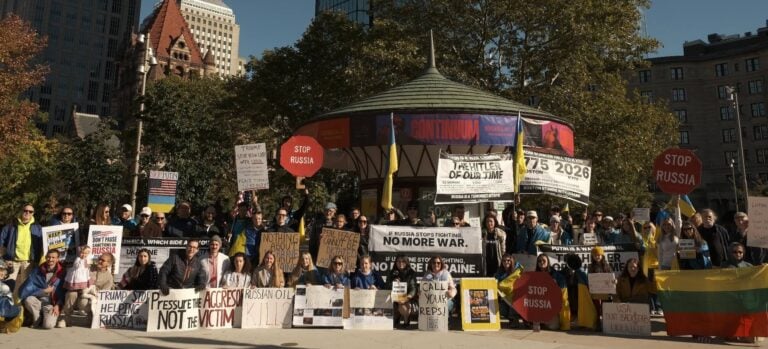
When talking about the influence of the Ukrainian community in the U.S., it is important to understand the unique characteristics of the American political system. American democracy has its own mechanisms for influencing the government, and mass street protests are just one of them. They can draw attention to an issue, but they do not guarantee a change in political course.
Large-scale demonstrations on various domestic and foreign policy issues take place regularly in the U.S.. However, our experience shows that if we want to achieve concrete results for Ukraine, we must work simultaneously on many levels – in Congress, in the media, with civil society organizations, business representatives, and various ethnic communities.
The UCCA’s activities are not limited to public events; we also maintain regular contact with members of the House of Representatives and the Senate, convey our position to political circles in both parties, collaborate with journalists, and strive to ensure that Ukrainian issues remain on the American public agenda.
We have developed partnerships with other communities, including Polish, Baltic, Georgian, Jewish, and Cuban. For example, in 1994, the UCCA was instrumental in founding the Central and East European Coalition (CEEC), which unites the concerns of over 20 million Americans citizens of Central and East European descent. Many of them have their own historical reasons to take a close interest in Russian aggression, authoritarianism, and international security issues. Working together helps us better explain to the American public why supporting Ukraine is in the interests not only of Ukrainians, but also of the U.S. and its allies.
We also work with business leaders. When influential businesspeople publicly support decisions that could weaken Ukraine’s ability to defend itself, it is important for Americans to understand the consequences of such decisions, especially in bringing attention to the American businesses that have been targeted by Russian attacks in Ukraine since Feb. 24, 2022. We view public communication and peaceful protests near commercial facilities as one way to draw attention to the responsibility businesses have for their influence on societal processes.
Our task is not simply to express disagreement, but to convey our arguments to as broad an audience as possible and to translate public support for Ukraine into concrete policy decisions.
We see a basis for this work. According to the sociological studies on which we rely, the majority of Americans supports aid to Ukraine and views Russia as an existential threat to American interests. At the same time, this support cannot be taken for granted – it must be constantly reinforced by explaining to Americans what is at stake.
Strength lies in unity
The Ukrainian community in the U.S. is not homogeneous; among Ukrainian Americans, there are supporters of both Democrats and Republicans, representatives of different generations of immigrants, and people with diverse experiences and views on US domestic policy.
From the very beginning, the UCCA has been an organization that unites the community around shared national interests, rather than party affiliation. We have contacts with people who have worked in both Republican and Democratic administrations, and we collaborate with representatives of both parties. This allows us to convey the Ukrainian position to various political circles, regardless of who is in the White House or leading Congress.
The diversity of our community is not a weakness but a strength. It enables us to speak to different audiences in the language of their values and interests. For some, the main argument is the defense of democracy; for others, it is national security; and for still others, it is the need to prevent aggressive authoritarian regimes from changing international borders by force.
Ukrainians who arrived in the U.S. after the start of the full-scale invasion deserve special attention. The issue of their future and immigration status remains critical, and we are working with our partners in Congress and other government officials to advocate for their interests.
At the same time, their contribution to supporting Ukraine is already extremely significant. The Ukrainian community in America is raising funds, organizing humanitarian aid shipments, and assisting hospitals and the civilian population. Since the start of the full-scale war, tens and hundreds of millions of dollars in aid have been sent to Ukraine through various community initiatives and charitable projects.
Not everyone can attend a demonstration or speak out publicly against a particular political decision. But helping Ukraine takes many forms, and each one is important. Our goal is to create opportunities for everyone who wants to get involved, regardless of their background, political beliefs, or life circumstances.
One area of our work is direct humanitarian support for Ukraine. I recently joined the Ukraine Focus mission to deliver ambulances that were collected in Europe and transported to Ukraine. This time, there were about fifty vehicles intended for the needs of Ukraine’s territorial defense forces and other units requiring medical transport.
Another important area is political advocacy. As early as 2000, the UCCA launched Ukrainian Days in Washington so that representatives of Ukrainian communities from across the country could meet with their congressmen and senators, representatives of research centers, diplomats, and other influential figures. Following Russia’s aggression in 2014, we stepped up this work.
We also collaborate with other initiatives to strengthen U.S. support for Ukraine. Overall, our guiding principle is that the voice of the Ukrainian community must be heard consistently, not just when another crisis arises.
Ukraine’s security is America’s security
For decades, American leadership and cooperation with European allies have been key factors in the stability of the democratic world. If the U.S. distances itself from its partners in Europe or gives the impression that aggression can be rewarded with concessions, the consequences will be felt not only by Ukrainians. This will affect allies’ confidence in American commitments, the ability to deter future conflicts, and the international system, in which the sovereignty of states should not depend on the strength of their neighbors.
We work earnestly to ensure that cooperation between the White House and Congress will pave the way for a more consistent policy toward Ukraine. It is important that our security issues not be turned into a tool for domestic political struggles, and that support for Ukraine remain a shared strategic interest of the U.S.
I often recall the words of American pastor Mark Burns, who, after visiting Ukraine and seeing things with his own eyes, said: “Ukraine is America First”. These words are particularly telling in the context of the “America First” slogan frequently used by President Trump. Their meaning is that defending Ukraine does not conflict with American interests. On the contrary, Ukraine is part of the democratic world, and the outcome of this war will affect security, stability, and the future far beyond its borders.
That is why we will continue to explain to Americans that aid to Ukraine is not just a matter of solidarity, but an investment in international security and the protection of the principles of American democracy.
To the people in Ukraine, I want to say that we are constantly working for victory for Ukraine. Ukraine remains in our thoughts, in our humanitarian work, in our meetings with politicians, and in every effort to convince the American public that our struggle matters to the entire democratic world.
Having been to Ukraine several times since Russia’s full-scale invasion, I, and my organisation, understand how difficult it is to live under constant rocket and drone attacks and how much depends on the support of our partners, so we will continue to work – in the humanitarian sphere, in political advocacy, and in building partnerships that help Ukraine endure.
I would like to thank Ukrainian Americans for their tireless work. Regardless of when they or their families arrived in the U.S., what political views they hold, or how they choose to help, their contribution is of great importance.
We must remain united around a common goal. We don’t have to agree on every issue of the American domestic policy to understand that a free, democratic, and sovereign Ukraine is in the interests of both Ukraine and the U.S.
Our task is to continue our work, expand our circle of partners, find new ways to convey our position, and turn support into concrete actions. I am convinced that a strong, democratic, and sovereign Ukraine will remain an important strategic partner of the United States for infinity. And that is precisely what we are working toward.
Cover: UCCA on Facebook
Latest news
 #UWC news