

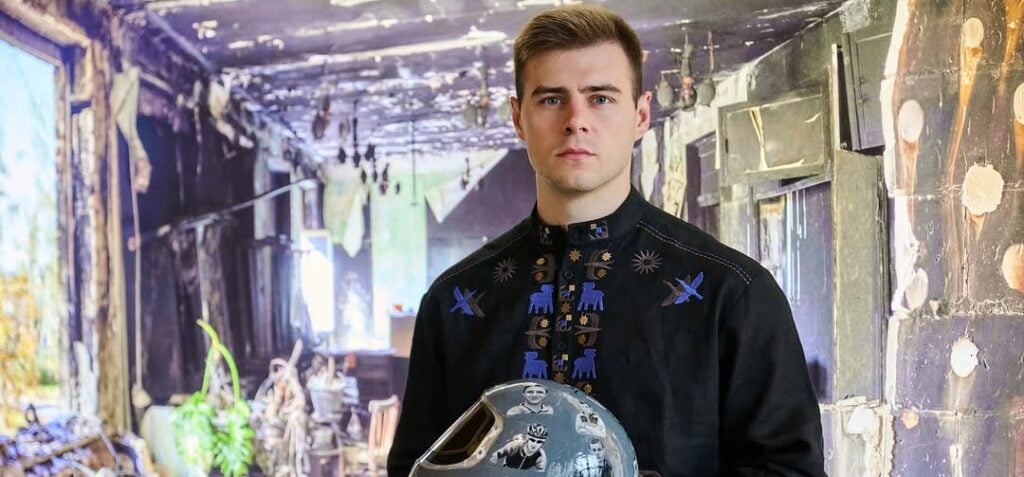


The name of Ukrainian skeleton racer Vladyslav Heraskevych made headlines in numerous international publications this February during the Olympics in Italy. Just 21 minutes before the start of the competition, the International Olympic Committee (IOC) disqualified the athlete for refusing to remove a tribute helmet featuring photographs of athletes who had been killed as a result of Russian aggression.
Heraskevych’s stand, which became one of the defining moments of the Olympics, was remembered as a symbol of values that transcend any competition. His call, “Remembrance is not a violation,” spread through international media and sparked a wave of support across major global platforms.
For Vladyslav, sports have never been “above politics.” Even before the full-scale invasion, at the 2022 Beijing Games, the athlete drew attention to the war through a silent protest, holding up a sign that read “No War in Ukraine.”
In 2022, world sports responded to the full-scale invasion by isolating Russia. Over time, however, international governing bodies began giving ground, step by step.
In an exclusive conversation with the Ukrainian World Congress (UWC), Vladyslav Heraskevych spoke about how the international sports system systematically plays into Russia’s hands, how his attitude toward Russian athletes changed after February 24, 2022, and why grassroots pressure from Ukrainian communities abroad can be more effective than any decisions made by sports federations.
The following is Vladyslav’s first-person account, edited and condensed for clarity and readability.
A one-way set of rules
The disqualification in Milan did not come as a complete surprise to me. I have been actively working on the suspension of Russian athletes since 2022, so over these years, we have studied how the system functions down to the smallest detail. There have been countless cases where it was blatantly obvious that the IOC is openly playing into Moscow’s hands and accommodating artificially created “neutral” athletes.
Officials drafted the most ambiguous neutrality criteria possible and turned a blind eye to glaring facts: that these athletes openly train in occupied Crimea, and that they are active-duty officers and soldiers in the Russian military. The IOC leadership always possessed this information. Yet, they deliberately allowed them to compete, violating the very rules they had established themselves. Add to this the fact that influential Russians who openly support the aggression still remain behind the scenes at the IOC, and the committee’s leadership continues to maintain excellent, almost friendly relations with them.
What truly shocked me in Milan was that the decision to disqualify me was made completely outside the rules. My tribute helmet did not violate a single clause of the official competition regulations. Lacking any legal basis, the IOC simply ignored basic human rights and freedoms and barred me from the Olympics, denying me even the chance to step up to the starting line.
When I was younger, I still held onto a certain naivety. It seemed that Olympic athletes inherently championed core values – peace, friendship, and unity. I sincerely wanted to believe that we were on the same wavelength and that sports were a sanctuary free from war. However, I was wrong, just as many other people were in their own fields.
Russian athletes are not merely staying silent; they are actively supporting Putin’s regime, participating in rally-concerts, and endorsing the aggression. We experienced this firsthand: at the start of the full-scale invasion, our team recorded a video message to our Russian colleagues, calling on them to condemn the war. In response, we received nothing but a torrent of personal threats on social media.
Previously, when major scandals broke out – such as the mass doping scheme at the 2014 Sochi Olympics – it always felt like the system alone was to blame, while the athletes were just hostages of circumstance.
I could understand ordinary Russians who had never been abroad, who live in their own isolated bubble and watch a single television channel – they simply lack access to information. But athletes travel the world constantly; they see the international community and life in other countries. They know perfectly well that life in Ukraine is normal and civilized, and that there is no oppression. Despite this, they consciously support the war and the murder of Ukrainians.
The Kremlin uses sports exceptionally well as a political weapon. The sheer scale of what is happening to sports within Russia is staggering: a recent investigation by foreign media revealed that the FSB unit responsible for swapping doping samples in Sochi is the exact same division that poisoned dissidents with Novichok.
Therefore, when Kirsty Coventry or other IOC officials repeat their mantra about “sports being beyond politics,” to me, it is utter absurdity. Sports are absolutely not separate from politics – they are a direct instrument of it.
Even choice of venue always serves as a valuable geopolitical asset that countries fight over. Sports are a part of politics and must bear responsibility for what they project. When Russians show up at tournaments, they broadcast war propaganda to both domestic and foreign audiences, and their performance under a national flag normalizes Russia’s actions in the eyes of the world.
Meanwhile, the scale of the tragedy in Ukraine has not changed – our cities are shelled daily, and an enormous number of people are dying. Yet, during my trips abroad, I increasingly notice a dangerous shift in sentiment: a perception that the war is practically over, everything is fine, Russians are competing again, and life has returned to normal.
Lawsuits, money, and embracing propagandists
The process of “unfreezing” Russia’s status is not accidental; it is the result of a combination of factors. The IOC does not decide on admissions single-handedly; it merely hands down recommendations. The final word rests with individual international federations, and here we see complete disarray. While World Athletics maintains a tough, principled stance and has closed its doors to Russians entirely, other sports are capitulating.
Russia is pouring colossal resources into legal warfare. In many disciplines, they are returning not through diplomacy, but through courts of arbitration. This is exactly what happened in my sport: at the official congress of the International Bobsleigh and Skeleton Federation, the global community voted decisively to suspend Russia. However, the Russians took the case to appeals arbitration, legally outmaneuvered the federation, and returned to the tracks against the explicit will of the sports community.
Ukraine’s major vulnerability is that we catastrophically lack a robust pool of sports lawyers and representatives within these legal institutions to counter such attacks symmetrically.
In other federations, their return is the result of basic backroom lobbying. The head of the International Gymnastics Federation (FIG), Morinari Watanabe of Japan, actually organized visits to Russia during the full-scale war. There, he was caught on camera hugging Nikita Nagornyy – a top Russian gymnast who also happens to lead Yunarmiya, an organization that militarizes children.
A similar situation is playing out in the International Chess Federation (FIDE), which is headed by Russian Arkady Dvorkovich. The Russian chess structure openly hosts tournaments in the occupied territories of Ukraine and forces abducted Ukrainian children to participate in them. Despite this, Russians enjoy a total carte blanche there. Dvorkovich himself calmly walked around the Cortina Olympics as a spectator, wearing a sweatshirt with USSR symbols and other banned paraphernalia, and the IOC pretended not to notice.
Visa bans and grandstand protests: a playbook for communities
In this reality, Ukrainian communities abroad possess a massive lever of influence that is often underestimated. When international sports officials surrender and admit Russians, the most effective tool available is advocating for visa bans at the government level of individual host countries. If an international federation grants permission, but the host country refuses to issue a visa, the Russian athlete stays home. We have achieved real victories on this front.
During the World Junior Curling Championships in Canada, the Russian team was granted entry. In pre-competition photos, we spotted them wearing banned St. George symbols. The All-Ukrainian Curling Federation immediately coordinated with the Ukrainian community in Canada, and we launched a wave of inquiries to Canadian government institutions. As a result, the visa review process for the Russians was delayed so significantly that the tournament began and concluded without them.
We pulled off a similar case with Russian taekwondo athlete Vladislav Larin, who in 2022 had openly raised money for the needs of the Russian occupying army. He was cleared as a “neutral” athlete and registered for the European Championship in Munich. We mobilized our embassy in Germany, the competition organizers, the SBU, and German government bodies. Consequently, Germany’s visa screening process held up the paperwork for the entire Russian taekwondo team, preventing them from traveling to Munich. This is exactly what targeted, systematic grassroots work looks like.
I am strongly against Ukrainian athletes boycotting competitions due to the presence of Russians. A boycott is a surrender. We would simply be handing them the global microphone voluntarily, while Ukraine fades from the radar. We must show up, win, and simultaneously create a backdrop of protest. This is where the community is irreplaceable. We need to organize pickets outside arenas, pressure sponsors, and engage with local media.
When our junior athletes staged a protest at the European Cup, the competition itself lost interest for the global press – every European media outlet wrote exclusively about the Ukrainians’ demarche against the war. Public pressure works perfectly; it forces the topic of Ukraine back into top headlines.
Actionable steps for Ukrainian communities:
- Track the schedules of international competitions in your host country well in advance – while it is still possible to influence the visa issuance process.
- Lobby embassies and organizers to demand visa denials for athletes who publicly support the aggression or compete displaying banned symbols.
- Establish contacts with national federations in your respective countries and persuade them to vote against the admission of Russians at international congresses.
- Organize public demonstrations during competitions featuring Russian participants; the media picks up on these, shifting the spotlight to the root cause of the protest.
- Support the grooming of Ukrainians to join the executive committees of international federations – as these are the bodies where critical admission decisions are made.
A hybrid threat
Sports are just one front in a massive hybrid war, where Russia is aggressively reclaiming ground through “soft power.” Look at the Venice Biennale, the appearance of Russian actors and films at the Oscars or Cannes, and the weaponization of the Moscow Patriarchate as an intelligence asset under a religious guise. Russia pours billions into these efforts. Meanwhile, any internal Ukrainian scandal is magnified globally, while our cultural achievements often go unnoticed.
Ukraine needs a greater presence not just in the offices of Western politicians, but directly on the streets of European and American cities. We must scale up Ukrainian cultural footprints abroad: host concerts, open exhibitions, launch high-quality English-language podcasts, and promote our culinary culture. The world needs to see that Ukraine is a modern, profound, high-tech European nation defending its home.
If we do not form analytical groups right now and begin systematically training and lobbying Ukrainian professionals into leadership positions on the executive committees of international federations, international sports will regress to where they were in 2015–2017 within five years. Russian state giants like Gazprom will once again become the primary sponsors of world championships, Russians will sit on every judging panel, and sports will fully devolve into a cynical tool used to rehabilitate the reputations of dictatorships.
Our only path forward is ironclad coordination: Ukrainian athletes, national federations, and the formidable resource of our communities abroad must operate as a single, unified force.
Cover: Vladyslav Heraskevych/Instagram