

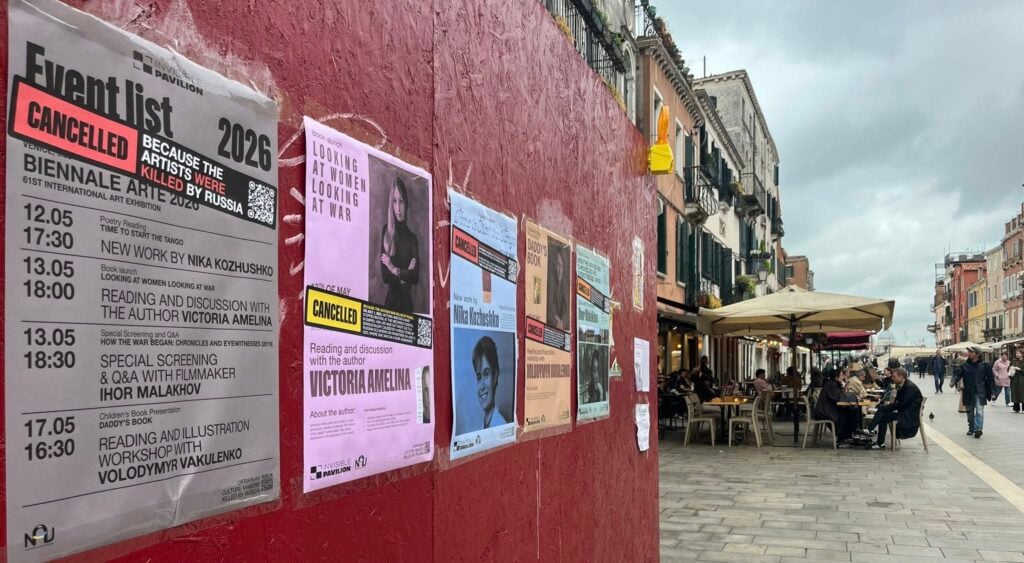


The Network of Associations for Ukraine (NAU), an Italy-based member of the Ukrainian World Congress, has launched the “Invisible Pavilion” project as part of the 61st Venice Biennale, which officially opens on 9 May.
The initiative has already gained wide attention in Ukrainian media. It consists of a network of posters placed across public spaces in Venice.
At first glance, the posters resemble a typical cultural programme, advertising exhibitions, film screenings and presentations. However, all listed events are marked as cancelled because their authors were killed by Russia.
The inscription “CANCELLED because the author was killed by Russia” turns the city into a visual map of loss and interrupted lives.
QR codes on the posters lead to a digital archive of artists and their works, forming a kind of “parallel memorial pavilion” unfolding across Venice as a space of testimony about destroyed culture and unrealised futures.
NAU is also supporting the KYIV | VENEZIA project, which transforms Ukrainian artefacts – fragments of destroyed buildings, everyday objects, audio and visual evidence of the war – into an installation in Venice’s public space.
On 9 May, these objects will be placed across canals, bridges and streets, forming a dispersed memorial installation. Each artefact is accompanied by a story accessible via QR codes, opening a digital archive and contextual information about its origin.
Separately, NAU is supporting the artistic action “From the Periphery of Empire to the Open Lagoon”, implemented within the decoloniz.art platform in Venice’s public space. The project highlights representatives of Indigenous and colonised peoples within the Russian Federation and draws attention to the link between Russia’s external aggression against Ukraine and its internal colonial practices.
It also references positions of European institutions, including resolutions of the European Parliament and the Parliamentary Assembly of the Council of Europe, which call for decolonisation processes and condemn policies of forced Russification and repression.
As part of a performative action, participants enter Venice’s public space presenting their stories, works and cultural testimonies. They become “living pavilions”, while the city itself turns into a stage for a public act of memory and visibility.
NAU emphasises that participation in these projects is a continuation of Ukraine’s cultural advocacy on the international stage.
“In 2026, the Biennale organisers decided to restore a pavilion we would have preferred to remain closed: it represents ideas that contradict the spirit of peace and harmony between peoples. We could not remain silent, so we launched and supported a number of initiatives with strong symbolic value,” the network said.
In this way, Ukrainian initiatives in Venice transform the Biennale into a multi-layered space of memory, where art becomes a tool for documenting historical experience and bearing public witness.
Read also: Biennale without neutrality: Ukrainians in Italy push back
Cover: Zoya Zvynyatskivska on Facebook