



We continue our series of conversations with representatives of Ukrainian communities about their experience countering disinformation. The first part focused on Portugal. This time, we examine the experience of South Africa, where Dzvinka Kachur, Regional Vice President of the Ukrainian World Congress (UWC) for Africa and co-founder of the Ukrainian Association in South Africa, explains the unique challenges of confronting Kremlin narratives.
Narratives around commemorative dates
Ukrainian commemorative dates, particularly Independence Day, are traditionally accompanied by a surge of the same recurring messages, Kachur says. These include denying Ukraine’s statehood and sovereignty, discrediting the Ukrainian government and society, and spreading false claims that Ukraine is losing the war.
South Africa offers concrete examples of how this works in practice. Russian actors have repeatedly attempted to associate the UWC and Ukrainian activists with fascism and terrorism. They have also run campaigns questioning Ukrainian democracy because elections are not held during wartime. To reinforce this narrative, Russian operatives even hired local residents to take part in a protest in Pretoria, handing them signs featuring portraits of Oleksii Arestovych and Valerii Zaluzhnyi with the caption, “Our President.”
“Of course, none of the South Africans holding those signs at the protest in Pretoria – who had no relationship to Ukrainians – had any idea who the people in the portraits were,” the UWC Vice President adds.
Ahead of the fourth anniversary of Russia’s full-scale invasion, the aggressor state promoted another false narrative – that it was winning the war.
While, for example, UWC Vice President Pavlo Sadokha observes that Portugal is particularly sensitive to issues related to its colonial past and relations with neighboring countries, propaganda in South Africa skillfully exploits a different historical fault line: racial discrimination. One of the narratives spread there claims that Ukraine is supported only by South Africans of a certain race.
This year, Kachur believes another theme will likely be added to the familiar set of narratives – “Ukraine doesn’t exist; it’s part of Russia,” “Ukraine is losing the war,” and “Ukrainians are suffering catastrophic losses.” The new focus will likely be recent changes in Ukraine’s Cabinet, particularly the dismissal of the defense minister. Public demands for government accountability will most likely be used to promote claims that the Ukrainian government is politically ineffective, illegitimate, and lacking democratic principles.
How to spot an attack early and prepare
The first sign of a coordinated campaign is synchronization. Within a matter of hours or a single day, multiple social media accounts and media outlets – often obscure ones – begin spreading the same topic or accusation with remarkable speed.
The second sign is emotion over facts. If a post is built not on verified information but primarily aims to provoke outrage, fear, or hatred, it is worth asking: who is trying to manipulate your emotions, and why? Emotions, Kachur emphasizes, are among the most common tools of manipulation.
These indicators are not exhaustive, however. Some topics genuinely gain organic public attention and spread rapidly because they resonate emotionally. It is therefore important to assess not only how quickly a narrative spreads, but also whether there are signs of coordination, who the sources are, and how credible they are.
According to Kachur, the most important step is to build strong communications campaigns of your own: clearly define the message you want to deliver and prepare well-tested, fact-based key messages in advance.
One objective of Russian information operations is to force Ukrainians to focus not on what truly matters, but on imposed smear campaigns. That is why the natural instinct to immediately debunk every falsehood should be resisted. Not every disinformation campaign gains significant traction or attracts the attention of local audiences. Before investing time and resources in responding, it is important to assess the scale of the attack – how widely the narrative is spreading, who is amplifying it, and whether it is resonating with local audiences.
A second recommendation is to identify in advance the people responsible for communications and clearly define who speaks on behalf of the organization or community.
The third is not to face the challenge alone. There are mechanisms for responding to information campaigns. If a narrative is spread by established media outlets, organizations can file complaints with the Press Council or under the Press Code to seek the removal of an article. Complaints can also be submitted to the human rights ombudsman or regarding hate speech. On social media, harmful posts can be reported for removal.
Partnering with experts who monitor the information space or with OSINT analysts helps communications teams make informed decisions about whether a narrative requires a public response or whether it is better not to amplify it with additional attention. It is equally important to build relationships in advance with media outlets, respected public figures, and opinion leaders who can help amplify your position. Such partnerships also help identify subtle issues that may not be immediately obvious and reduce the risk of communication mistakes.
Respond or ignore?
If a campaign has not gained noticeable public traction, publicly debunking it may only draw additional attention to it and unintentionally help spread the falsehood. Kachur cites a telling example: in one of their reports, Russian propagandists boasted that the British High Commissioner had been forced to publicly respond to narratives they had spread in Namibia. For the Kremlin, this was proof that the operation had achieved its objective by compelling a diplomat to amplify a fabricated issue.
Before responding to disinformation, it is therefore essential to assess its actual reach and impact. Not every falsehood requires a public rebuttal. In some cases, the more effective strategy is not to amplify the manipulation but to continue consistently communicating your own fact-based messages.
According to Kachur, the most common mistake organizations make during information attacks is reacting emotionally – especially when a specific individual, rather than just an organization, becomes the target. The desire to quickly refute every falsehood often leads to different representatives communicating without a coordinated position or relying on unverified information. Conflicting or inaccurate messaging can undermine trust in an organization more than the attack itself.
A crisis communications plan
It is impossible to prepare for every possible scenario, but having a predefined action plan is critical. Such a plan should clearly identify who makes decisions, who should be involved in discussing the situation, and who is responsible for external communications. It is not a collection of ready-made responses to every issue but rather an organisational process: assessing the situation, discussing it, deciding whether to respond publicly, determining how to respond, or consciously choosing not to comment. The key, Kachur stresses, is that decisions should be based on an analysis of the facts, the scale of the campaign, and its potential impact – not on emotions.
Coordination depends on the specific narrative being spread. If an attack affects not only a particular organization or Ukraine in general but also partners or government institutions, they should be informed promptly so that a common position can be coordinated. If there is cooperation with fact-checkers, OSINT analysts, or researchers studying information operations, they should be alerted so they can document the campaign, analyze dissemination networks, and assess its true scale and impact.
According to Kachur, specialized software is not essential for detecting the beginning of a campaign. Regularly monitoring mentions of your organization across the information space is often sufficient. A strong network of local partner organizations also frequently serves as an early warning system when suspicious activity emerges.
Three steps if you become the target
If a community or an individual comes under attack, Kachur recommends a three-step approach.
- First, do not panic or react emotionally. Pause and assess whether this is truly a coordinated attack or simply isolated negative comments.
- Second, do not face it alone. Discuss the situation within your organization, inform partners if necessary, and consult experts or OSINT analysts to jointly assess the scale of the campaign and determine whether a public response is warranted.
- Third, document everything. Save links, take screenshots, record publication times, and identify the main accounts spreading the narrative. This documentation may later prove useful for analysis, reporting content to platforms, or, if necessary, contacting the appropriate authorities.
Strength in unity
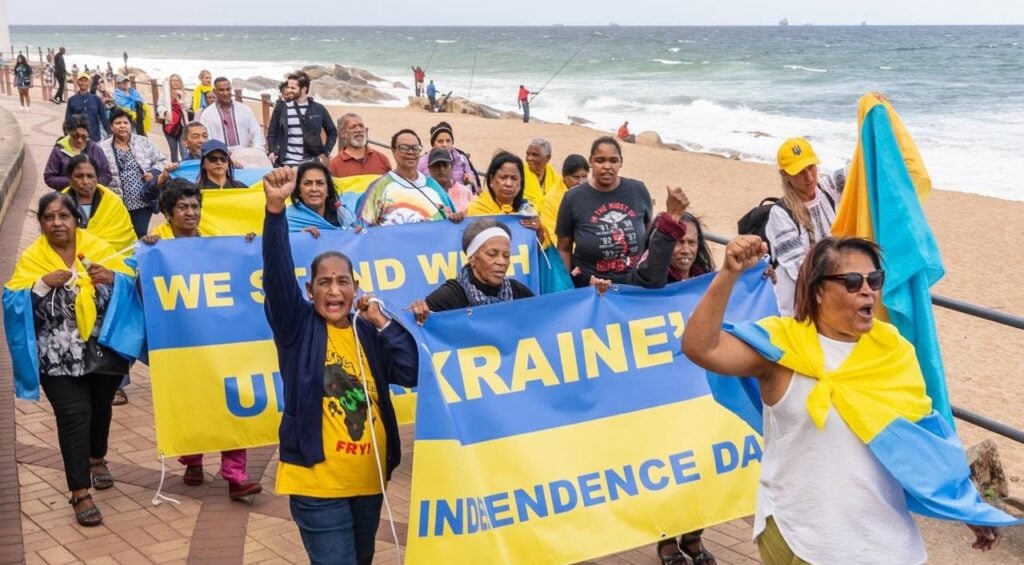
As Ukrainian communities abroad prepare for Independence Day, Kachur believes they should above all remember the importance of unity. Effective cooperation among Ukrainian organizations, together with close collaboration with local partners, makes the community’s voice stronger and more visible.
The UWC has more than 60 years of experience countering information attacks. Historical archives show that the Soviet Union waged campaigns against Ukrainian organizations and independence activists for decades. According to Kachur, today’s attacks often rely on the same narratives – and sometimes even the same networks – to spread them. Yet despite all those efforts, Ukrainians ultimately secured their independence. That is why, Kachur says, Independence Day is above all an opportunity to tell the world about Ukraine – its culture, history, struggle, and people.
Ahead of Independence Day, Kachur recalls the words of Taras Shevchenko:
“Keep fighting – you are sure to win! God is helping you! Truth is on your side, glory is on your side, and holy freedom is on your side!”
Truth, unity, and mutual support, she emphasizes, are the greatest strengths of the Ukrainian community.
Happy Independence Day, Ukraine! Glory to Ukraine! Glory to the Heroes!
Cover: UAZA on Facebook