

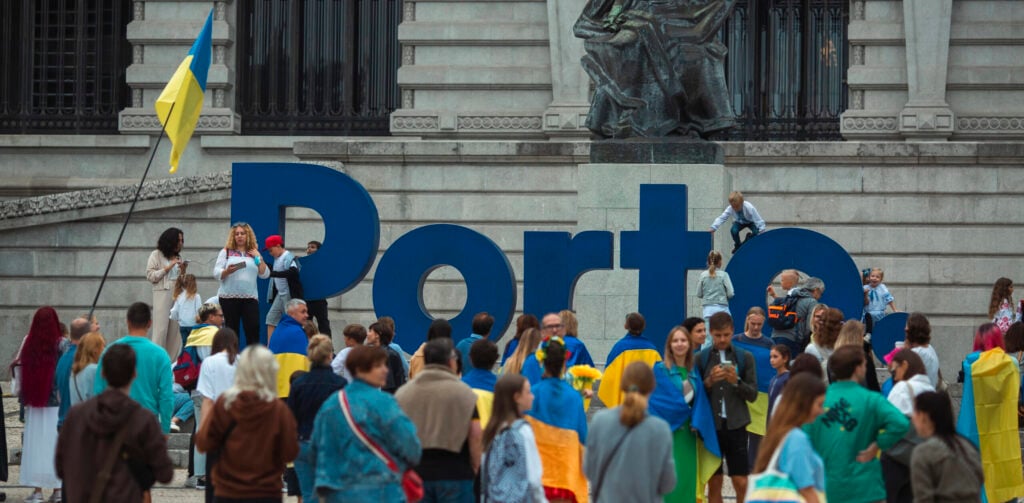


Russia’s war against Ukraine has a dimension that rarely receives as much attention as the fighting itself: the battle for public opinion in countries whose continued support for Ukraine is critically important. This battle is being fought not only by diplomats and major media outlets, but also by Ukrainian communities abroad – often without dedicated resources, relying instead on daily monitoring, personal relationships with journalists, and the credibility they have built over time.
Kremlin information attacks are rarely random. They tend to emerge when a specific political decision is approaching in a host country – a new sanctions package, a parliamentary debate, or a high-level political visit – and are designed to influence that decision. That is why communities must be selective in their response. Not every provocation deserves attention, but when an important political decision is at stake, or when local media lack access to verified information, community engagement can make a real difference.
The issue is especially timely ahead of Ukraine’s Independence Day. Portugal traditionally welcomes government officials and prominent politicians to events marking Aug. 24, and the Ukrainian community plans to use their presence to raise the issue of sanctions directly.
This is the first article in a series exploring how Ukrainian communities around the world counter disinformation. In the second installment, we speak with Dzvinka Kachur, Regional Vice President of the Ukrainian World Congress (UWC) for Africa and co-founder of the Ukrainian Association in South Africa. We begin, however, in Southern Europe.
Pavlo Sadokha, Vice President of the Ukrainian World Congress (UWC) for Southern Europe and President of the Union of Ukrainians in Portugal (UUP), explains what this struggle looks like from inside Portugal.
A message that hasn’t changed
According to Sadokha, the Kremlin’s messaging has remained virtually unchanged since 2014 – and in some cases reaches back to events from the Revolution of Dignity. The core narrative is the same: that “Ukrainian Nazis” allegedly seized power and that Russia is trying to “liberate” Ukrainians from them. Only the pretexts for repeating this message change.
This year, one such pretext has been the deterioration of Polish-Ukrainian relations, which has been amplified by certain political forces in Poland. Interestingly, even countries that have no direct stake in the debate – Portugal, for example – prefer to avoid the topic, fearing it could “open Pandora’s box” by reviving painful historical disputes with neighboring countries, particularly those connected to the country’s colonial past.
In Portuguese media, pro-Kremlin commentators continue to promote the claim that the West is supposedly waging war against Russia through Ukraine while portraying Ukrainians as adherents of far-right ideology. Sadokha also points to the Russian Orthodox Church as another channel for spreading these messages across Europe, particularly through claims that the Russian Orthodox Church is being persecuted in Ukraine.
The most pressing subject of information attacks today, he says, is the EU’s 21st package of sanctions against Russia. According to Sadokha, Portugal, Germany, Austria, and especially Greece are currently pushing to ease some of the restrictions, including those affecting imports of certain types of fish into Portugal. An information campaign has already begun, seeking to convince Europeans that the war is inflicting excessive economic damage on their own countries.
In this situation, Sadokha argues, the role of Ukrainian communities is not to deny the obvious – there are genuine economic costs – but to provide a broader perspective: Ukraine’s victory would free Europe from years of Russian economic blackmail and make it possible to build a new framework for the continent’s economic security.
Where – and how – to respond
As an example of a specific information operation, Sadokha recalls the case of children being taken to a camp in occupied Crimea. In his view, the campaign was aimed less at a Portuguese audience than at creating the impression that even children from NATO countries supposedly feel safe in Crimea.
The community discovered the campaign through constant monitoring. According to Sadokha, members track publications by Kremlin-linked actors, websites affiliated with the Russian Orthodox Church, and the Russian embassy every day. When they identify an attempt to influence public opinion, they respond by debunking it.
Sadokha also highlights the Portuguese Communist Party, which he says deliberately organizes campaigns aimed at reducing support for Ukraine. The most effective response, he argues, is identifying the original source of a claim. Demonstrating that a narrative originates from a specific Russian propaganda outlet rather than being supported by factual evidence is often the strongest rebuttal in itself.
Portuguese audiences, Sadokha notes, simply do not read the community’s Ukrainian-language resources. As a result, almost all outreach is conducted in Portuguese. The community created the Facebook group Ukrainians in Portugal, where it publishes analytical content in Portuguese, while Sadokha himself writes a blog for the newspaper Observador. There, he addresses current issues – for example, he recently explained Ukraine’s position on Polish-Ukrainian relations, deliberately avoiding historical disputes and focusing instead on the risks such tensions pose to broader European stability.
Television and radio are another important channel. According to Sadokha, traditional media still enjoy greater public trust than social media in many European countries, so the community regularly invites journalists to its events and gives interviews whenever an opportunity arises.
On the political level, the community works closely with the Portugal–Ukraine parliamentary friendship group. According to Sadokha, nearly all of its members will travel to Kyiv on August 24 to mark Ukraine’s Independence Day.
For Ukrainian communities abroad that are only beginning to establish relationships with local media, Sadokha’s advice is simple: don’t be afraid of seeming too persistent. Reach out to journalists, tell them about your activities, and make your community visible. In his experience, even a small community can attract media attention if it has people who communicate its message consistently and systematically – not just one spokesperson who appears occasionally.
He also notes that journalists themselves are often looking for stories about how Ukrainians are integrating into local society. That makes it important to have a trusted contact person who understands both the community’s position and Ukraine’s broader perspective.
Not every false claim requires a response. Sadokha distinguishes between situations where disinformation could genuinely influence a political decision – in which case an active response is necessary – and cases where other credible sources are already providing effective fact-checking. For example, the community deliberately leaves reporting on Russia’s military offensive to war correspondents working on the ground, where additional messaging from the diaspora would add little value.
Where local media lack access to reliable information, however, the community steps in – filling gaps in the information space with facts and verified reporting.
Cover: DepositPhotos