

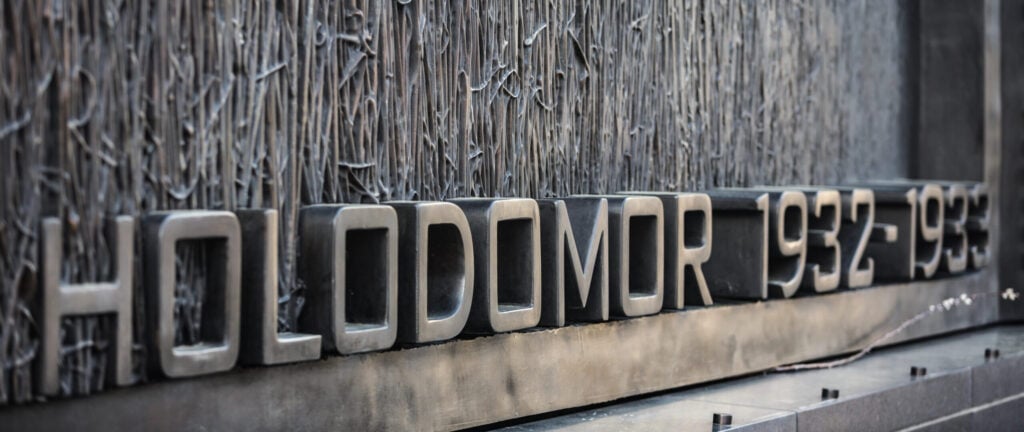


Preserving the memory of the Holodomor of 1932–1933 — the genocide of the Ukrainian people — and spreading the truth about this crime worldwide is an important mission for the global Ukrainian community. We offer a selection of materials from partners of the Ukrainian World Congress (UWC) — the Ukrainian Institute of National Memory and the National Museum of the Holodomor-Genocide. These videos, books, brochures, eyewitness accounts, and documentary exhibitions, including those in foreign languages, will help inform the international community about the tragedy of Ukrainians, honor the memory of the victims, and counter oblivion.
Videos
- Video “The Holodomor of 1932–1933. Revenge for our Freedom” in English
- Video history “Why did the Holodomor become possible?”
- Video clip “The Holodomor as a response to peasant uprisings”. The video covers the background and causes of the Holodomor of 1932–1933. Subtitled in English and Ukrainian.
- Extended interview with Holodomor researcher Volodymyr Tylischak on the resistance of Ukrainian peasants to collectivization in the early 1930s.
- Series of videos “The Indomitable” about people who survived the Holodomor or witnessed it and not only survived physically, but also refused to let their spirit be destroyed.
- Series of videos “Holodomor – Revenge for Freedom”
- “A matter of life and death: gathering grain from Ukraine”: a historical video for the 100th anniversary of the famine of 1921–1923. Download with English subtitles.
- “Famine after Victory”: marking the 75th anniversary of the mass famine of 1946–1947. Download with English subtitles.
- Requiem film “Names on the Wall”. Download. Names on the Wall. Honouring the victims of the genocide of Ukrainians. Download.
Books and brochures
- Oral testimonies about the Holodomor on the online platform of the Oral History Archive.
- Brochure “Ukraine 1932–1933. Genocide by Famine”. Brochure available in Ukrainian, English, Spanish, French, German, Arabic, and Greek.
- Brochure “Holodomor: Communist Genocide in Ukraine”. Download.
- Brochure “The Holodomor failed to break us” [“Голодомор не зламав”]. Download. Download.
- Exhibition catalog book “Resistance to Genocide”. Catalog.
- Book “Repressed Diaries. The Holodomor of 1932–1933 in Ukraine”. A collection of diaries and notes by seven eyewitnesses of the Holodomor who recorded what they saw, heard, and experienced. View and download the electronic version of the book.
- Book “Humanity in an Inhuman Time” (2nd edition) tells about benefactors who helped starving people survive in 1932–1933. View and download the electronic version of the book.
- Collection of memories by Anastasia Lysyvets “Speak of the Happy Life” [“Скажи про щасливе життя”]. View and download the electronic version in Ukrainian. View and download the electronic version in English.
- Iryna Reva’s book “Beyond Oneself” addresses the socio-psychological and cultural consequences of the Holodomor and Stalinist repressions. View and download the electronic version of the book.
- Book “Memory of the Kin” – 16 stories of families that survived the Holodomor of 1932–1933. View and download the electronic version of the book.
Internet banners
- Project “Memory That Saves: Voices of Truth” tells about individuals who did not remain silent about the Holodomor. View and download.
- Project “The Holodomor Failed to Break Us” features people who survived the Holodomor, preserved their physical lives, and kept their spiritual integrity intact. Despite the trauma experienced in 1932–1933 and unfavorable conditions under the Soviet regime in subsequent years, they became artists, writers, and achieved success in science and other fields. View and download.
Exhibition projects
- Exhibition “Resistance to Genocide”. The exhibition dispels the myth about the lack of resistance by Ukrainian peasants against Bolshevik plunderers right before and during the Holodomor of 1932–1933, detailing the forms, methods, and scope of resistance based on archival documents. Exhibition stands for viewing and downloading.
- Exhibition “Ukraine 1932–1933. Genocide by Famine” introduces the international audience to the history of the Holodomor of 1932–1933 and explains why it constitutes a genocide. Exhibition stands available via link in Ukrainian, English, French, Spanish, Portuguese, and German.
- Why the Holodomor is a genocide of Ukrainians: English-language social media carousel. https://t.me/uinp_gov/1345
List of UINP videos on the Holodomor with English subtitles
- Famine of 1921–1923:
- https://youtu.be/CP44Ue6rGG8
- The famine in Ukraine 1921–1923: https://youtu.be/56-kvBd5VxI?si=mTtaCVzNL7Eaafbg
- https://mega.nz/folder/p8B0mDKL#_7iBIgUjhBL-U_l7Sv3V_w/file/d0JQnbBC
- “Starvation as Murder”. UINP presents a new video for the Holodomor Victims Remembrance Day, 1932–1933:
- “Starvation as Murder”: presents a new video for the Holodomor Victims Remembrance Day, 1932–1933:
- Famine of 1946–1947:
- https://youtu.be/X0k4LHPVHUg
- “Famine after Victory”: video for the 75th anniversary of the mass famine of 1946–1947 [English subtitles]: https://youtu.be/5Qb_m_vAicw?si=4pzjG-JxaSAQvxf4
- https://mega.nz/folder/IgQCwRqb#GSYzGmBoxt6bQNTsX1I9FQ/file/sgJAHDaK
- The Holodomor as a response to peasant uprisings:
- Uprising against famine [English subtitles]: https://youtu.be/A6VU3EIgggQ?si=vd87YYbtiAFn80JA
- Website of the National Museum of the Holodomor-Genocide:
- Link to brochure layouts “Holodomor: Basic Facts” in Ukrainian and English. Includes files for viewing and separate files for printing.
Cover: DepositPhotos
Latest news
 #GlobalAdvocacy
Russia seizes foreign businesses: Turning Kremlin blackmail into advocacy tool
 #LocalAction
Russia’s nickel in Finland: Ukrainians demand closure of sanctions loophole
 #CallToAction