



Moscow is ramping up its aggressive rhetoric toward the Baltic states. On Sept. 25, the Russian state news agency RIA Novosti published and, three hours later, deleted an article threatening Lithuania with a “short special military operation” and a nuclear strike.
On Sept. 29, Estonia stated that the arson attack on defense company Milrem Robotics in August was an act of sabotage organized on orders from Russian intelligence services. And on Oct. 1, Vladimir Putin threatened to use Russia’s entire arsenal of weapons in the event of an attack on Kaliningrad, the Russian exclave between Poland and Lithuania.
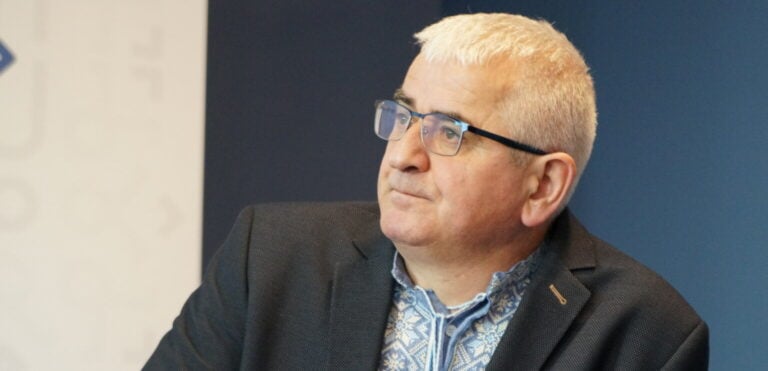
The Ukrainian World Congress (UWC) spoke with Vira Konyk, President of the Congress of Ukrainians of Estonia (CUE), about how real the threat of an attack is, how Estonians are responding to it, and what the Ukrainian community is doing.
From propaganda to sabotage
Moscow has long used a broad range of tools against Tallinn and the Baltic region as a whole – from information propaganda to direct acts of sabotage and forceful provocations, Vira Konyk says.
The CUE president describes this as a “small cuts” tactic – an attempt to keep society under tension and test the country’s defenses. Konyk points to the damaged power cable between Estonia and Finland, incursions by Russian fighter jets, and provocative border crossings by Russian border guards.
The recent act of sabotage at an Estonian defense plant was also telling, she says. Estonia’s security service quickly identified the perpetrator, so Tallinn’s accusations are well-founded, even though the Kremlin denies everything.
“Russia acts through both direct intimidation and sabotage. I think all of these methods are already very familiar to Ukraine,” Konyk says.
At the same time, Konyk considers a scenario replicating the Donbas in 2014 – such as an attempt to establish a “puppet republic” in Narva under the pretext of protecting Russian speakers – to be unlikely. Although some locals sympathize with Russia, most do not want war and value Estonia’s high standard of living, she says.
Still, the military is preparing for the worst. Konyk recalls a fitting response from an officer of the Kaitseliit (Estonian Defense League) when asked about the likelihood of an attack: “The question is not whether an invasion is possible, but when it will happen.”
Estonia is therefore strengthening its defenses without unnecessary noise or panic. The population is being calmly prepared for any kind of crisis – from natural disasters to war – and many people keep “go bags” ready.
The Ukrainian community here shares its own experience, having already gone through this process, Konyk says. Estonia, meanwhile, is carefully taking Ukraine’s lessons into account, following the principle that “forewarned is forearmed.”
As for doubts about NATO’s unity and its fulfillment of Article 5 on collective defense, Vira Konyk urges people not to pay attention to statements by individual politicians. She is convinced that the alliance would intervene in the event of a real attack, because the world understands that if Russia were to seize the Baltics, it would not stop there. The countries that have already experienced Soviet occupation understand this first and foremost.
“There is now an emerging understanding that Russia must be stopped by all possible means,” she emphasizes.
A course toward victory
Sharing her experience in countering hybrid threats, Vira Konyk calls on Ukrainian communities in Europe to act proactively.
Here is one of many examples of such efforts. Even before the full-scale invasion, the CUE established a monitoring group that included a lawyer and monitored publications containing discriminatory rhetoric against Ukrainians. The group then sent an open letter to government authorities and media outlets, demanding an end to discrimination against Ukrainians in the media based on relevant international and Estonian legal documents.
After that, the public broadcaster ETV+ devoted a separate broadcast to the issue, and the number of information attacks decreased significantly. Similarly, after appealing to the Ministry of Culture and raising public awareness, the community recently succeeded in getting concerts by the pro-Russian duo “Kroliki” canceled.
Konyk considers the Estonian parliament’s adoption of a statement not simply in support of our country, but specifically in support of Ukraine’s victory, an important signal to the international community. This is also backed by practical cooperation in the defense sector – including technology exchanges, joint production of weapons and ammunition, and the possible relocation of some Ukrainian defense companies to safe territory in Estonia.
“We need to act proactively and not wait. In a state governed by the rule of law, these tools really do work,” Konyk concludes.
Cover: DepositPhotos
Latest news

 #GlobalAdvocacy
Russia seizes foreign businesses: Turning Kremlin blackmail into advocacy tool
 #LocalAction