

Germany – one of Kyiv’s key allies in Russia’s full-scale war against Ukraine – has repeatedly been targeted by Russian disinformation attacks. Propaganda operations intensify in the country particularly around elections, as data from Ukraine’s Center for Countering Disinformation at the National Security and Defense Council shows.
However, support for Kyiv is not the main reason Germany’s media ecosystem is vulnerable to Kremlin influence. Communications researcher and essayist Danylo Poliluev-Schmidt argues that Germany’s unresolved totalitarian past, along with an inflexible system of coordination between federal and state authorities, creates favorable conditions for Russian propaganda.
Poliluev-Schmidt believes Ukraine’s experience in countering Kremlin disinformation could provide Germany with an effective tool for fighting it. He makes this case in his book The Armed Truth: What Germany and Europe Can Learn from Ukrainian Media.
The book has already been published in German as Die bewaffnete Wahrheit: Was Deutschland und Europa von den ukrainischen Medien lernen können, while an English-language edition is expected soon. The Ukrainian World Congress (UWC) spoke with Poliluev-Schmidt, who explained how his work could help Ukrainian communities better tell the world the truth about Russia’s war.
Below is the author’s direct account, edited and shortened for ease of reading.
An unwieldy system
The issue of Russian propaganda’s influence extends across Germany’s entire media ecosystem – not only traditional media, but also social networks, state institutions, civil society organizations and informal initiatives.
One of the main problems is the complexity and fragmentation of Germany’s system. Germany has 16 federal states, each with its own government, while a federal government operates alongside them. Responsibility for combating cybercrime, disinformation and anti-constitutional threats is divided among a large number of institutions that do not always cooperate effectively enough.
This is partly explained by Germany’s historical experience. After its Nazi and communist past, the country deliberately created a system of checks and balances designed to prevent excessive state interference in society. As a result, German institutions are less centralized and less flexible than Ukrainian ones.
Ukraine, by contrast, began viewing Russia as a source of a direct threat much earlier. This understanding developed over decades – from Russia’s attempts to establish control over Crimea and the conflict around Tuzla to the 2008 war against Georgia, its support for Viktor Yanukovych’s regime, and the subsequent occupation of Crimea and parts of the Donetsk and Luhansk regions.
 The Armed Truth: What Germany and Europe Can Learn from Ukrainian Media. Photo: Fedorchenko Alyona, Vitsche e.V.
Ukrainian society also saw how Russia uses not only military but also political, economic and cultural tools of influence. As a result, by the time of the full-scale invasion, Ukraine already had a much deeper understanding of Russian methods.
Germany did not have this experience. For decades, Russia succeeded in cultivating a positive image through culture, sports and other spheres that were often viewed as apolitical. Ballet, Tchaikovsky and sporting ties were considered separately from politics, even though culture can also be a tool of political influence.
Economic dependence on Russian oil and gas resources accelerated the formation of an environment in which Kremlin influence was long perceived as a normal part of relations. Historical perceptions of Russia also played a decisive role.
However, Germany’s situation was only one part of the West’s broader approach to relations with Russia. For a long time, there was a belief that economic cooperation and integrating Moscow into the European system would gradually contribute to its democratization. At the same time, no demands, such as reforms in Russia, were made in return, creating an asymmetric model of relations.
False balance
Another problem concerns the principle of journalistic neutrality, which in Germany is often interpreted as requiring the positions of all sides to be presented equally. But this approach can create a false balance in which the aggressor and the victim are effectively placed on the same level.
For example, when Ukraine said that Crimea had been seized by Russian troops or that Russia was waging aggression against Ukraine, the German media space often used the formula “two sides of the conflict,” creating the impression that Kyiv and Moscow were equally responsible for what was happening.
Independent Ukrainian journalism draws a much clearer distinction between the aggressor and the victim. This does not mean abandoning independence or self-criticism. On the contrary, Ukrainian media can criticize their own government while also directly calling Russia the aggressor.
The problem of false balance is particularly visible when statements by independent Ukrainian media are placed on the same level as statements by Russian government officials. When a report by an independent Ukrainian outlet and a statement by, for example, Peskov are presented as two equally valid versions of events, this in itself distorts the picture. Russian official information, after all, often contains claims that can be disproved by facts.
What Europe can learn from Ukraine
Ukraine’s experience is important above all because of the existence of an entire media and civil society ecosystem in which independent journalists, civil society organizations, informal initiatives, media outlets and publishers interact with one another. This approach makes it possible to respond quickly to new information threats.
In Germany and other EU countries, such cooperation is currently much weaker. At the same time, alternative media and influencers are gaining increasing influence, working faster and more emotionally than traditional newsrooms. They do not always verify information and sometimes deliberately distort it.
An influencer may talk about bodybuilding, fashion, piercings or everyday life, while gradually spreading Russian, far-right or far-left narratives alongside these topics. Audiences come for entertainment or advice but receive political messages at the same time.
This creates a favorable environment for Russian narratives and fosters a falsely positive perception of Moscow. As a result, even after the start of the full-scale war, there are still people who believe it is possible to return to normal economic relations with Russia.
In Ukraine, these mechanisms began to be understood much earlier. For example, fact-checkers can work directly within media formats and explain to audiences where a politician or blogger is manipulating them, using unreliable sources or spreading lies. In Germany, similar practices are only beginning to develop.
In addition, Ukraine’s experience demonstrates that it is important not only to create quality content but also to build trust in information sources. Public broadcasting – Suspilne – plays an important role in this. Ukrainian media also actively use TikTok, YouTube and Instagram, where audiences receive information much more quickly.
German politicians increasingly understand the scale of the threat. At the state and European Union levels, mechanisms to counter disinformation and foreign interference are already being established. But time is working against us.
Russian, Chinese and Iranian propaganda are already exploiting social problems in European societies – inequality, problems facing young people, the labor market, unemployment and other real divisions.
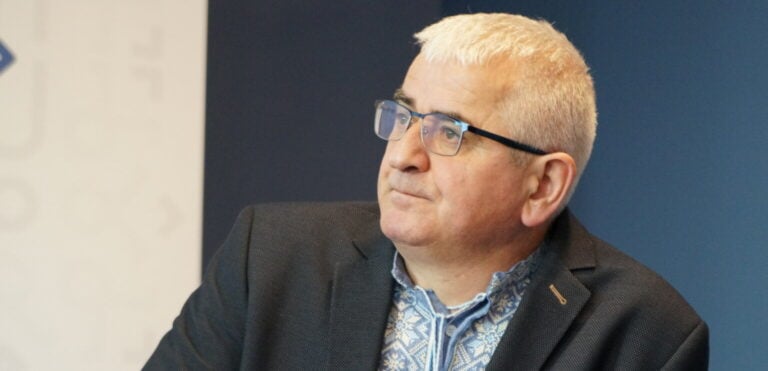
 Danylo Poliluev-Schmidt. Photo: Fedorchenko Alyona, Vitsche e.V.
Particularly dangerous is the combination of different problems into a single information narrative. People may simultaneously be told about economic difficulties, migration, war, social inequality and the problems facing Generation Z, creating the impression that all these phenomena have a single cause.
There is still a lack of understanding in society that supporting Ukraine and countering Russian influence are not merely matters of solidarity with Ukraine. They are strategic tasks for Germany itself, because Russian disinformation directly affects German society and political processes.
What Ukrainian communities can do
Ukrainian communities abroad need to make greater use of Ukraine’s experience and learn to advocate for it. This is not only about demonstrating specific practices that could be useful to other countries. It is important to establish an ongoing dialogue between Ukrainian and Western journalists, as well as between Ukrainian civil society organizations and local institutions.
In addition, there is no need to try to reach everyone at once – it is much more effective to choose a specific community, a specific organization and a specific issue related to disinformation. For example, you could invite a Ukrainian journalist or photojournalist, organize a film screening or discussion, or find a joint project.
Speak to different audiences through topics that are close to them. For progressive groups, these could include sexualized crimes committed by Russian troops; for “green” audiences, ecocide; and for conservative audiences, the deportation of children, language and cultural preservation. Also look for specific points of connection with the local historical experience.
It is also worth working with foundations and think tanks associated with different political forces. Do not limit yourself to one part of the political spectrum when seeking Ukraine’s victory in the war.
The key is not simply to talk about Ukraine’s experience, but to show why it matters to a particular country, a particular community and a particular issue, so that Ukraine becomes a necessary and integral part of the European context.
Cover: DepositPhotos
Latest news
 #GlobalAdvocacy
Russia seizes foreign businesses: Turning Kremlin blackmail into advocacy tool
 #LocalAction