




When the European Union banned the broadcasting of Russian state outlets RT and Sputnik following the start of Russia’s full-scale invasion of Ukraine, it marked one of the bloc’s most significant steps in countering Kremlin disinformation. Moscow lost its primary media platforms in Europe – but it did not lose its ability to influence public opinion.
Over the past several years, Russian propaganda has not disappeared – it has adapted. Instead of relying solely on state-run television networks, the Kremlin increasingly uses individual journalists, commentators, analysts, and even respected Western media outlets that – knowingly or unknowingly – become platforms for spreading Russian narratives.
Two stories from France and Canada this week illustrate different aspects of the same problem.
When bans are not enough
On August 3, a Paris court rejected an appeal by Xenia Fedorova, the former head of RT France, upholding the decision to deport her from France and freeze her assets. French authorities accuse her of involvement in spreading Russian propaganda.
At first glance, this may appear to be just another chapter in the fight against a banned Russian state broadcaster. But the story is more complex.
After RT France ceased operations, Fedorova did not disappear from the public sphere. She continued working as a commentator for the French television channel CNews, which has repeatedly been criticized for giving airtime to pro-Russian voices. The case illustrates a key feature of Russia’s current information strategy: when one channel of influence is shut down, others quickly emerge.
Volodymyr Kogutyak, UWC Vice President in Western Europe and head of its Advocacy Committee, says the problem goes far beyond individual personalities.
“It would be a mistake to think the problem is limited to one person. In reality, it is part of a much broader system of information influence that has been built over many years through a network of media platforms, experts, and commentators who promote Russian propaganda under the guise of presenting an alternative point of view.”
Kogutyak says that French President Emmanuel Macron publicly described RT and Sputnik as tools of Kremlin propaganda as early as 2017. Yet even after the EU sanctions, some French media outlets continue to regularly invite commentators who promote or justify Russian narratives.
Of particular concern is the growing visibility of such narratives ahead of France’s 2027 presidential election. The Kremlin has long used election campaigns in democratic countries as opportunities to deepen social divisions and undermine public trust in state institutions.
A different tool – mainstream media
If the French case shows how RT-affiliated figures have found new platforms after the network’s ban, the Canadian case highlights another challenge: the appearance of Russian narratives in influential Western media.
In late July, the Ukrainian Canadian Congress (UCC) wrote to The Globe and Mail Editor-in-Chief David Walmsley after the newspaper published, for the third time in less than a year, reporting by Goran Tomašević, a journalist accredited by Russia’s Ministry of Foreign Affairs.
In its letter, the UCC argued that the articles portrayed Russian soldiers sympathetically while omitting any mention of war crimes, torture, forced deportations, and other crimes committed by Russian forces. The strongest criticism focused on stories about the Akhmat special forces unit, which failed to mention its documented involvement in crimes against civilians.
The UCC also raised a broader question for the newspaper: under what circumstances was the journalist granted accreditation by the Russian authorities, given that the Kremlin has traditionally allowed access only to foreign reporters whose presence serves its information interests.
The case shows an important characteristic of modern propaganda. It does not always spread through openly pro-Russian outlets. Instead, Russian narratives can reach audiences through media organizations that the public generally considers trustworthy. When readers encounter a story in a major national newspaper, they are less likely to question how the facts, sources, or context were selected.
Propaganda works differently today
Russia’s information strategy today differs significantly from what the world saw a decade ago.
Where the Kremlin once relied primarily on its own state television channels, it now increasingly uses far more subtle methods of influence. The strategy is no longer based solely on outright falsehoods. Selective omission of facts, emotionally compelling stories presented without essential context, false equivalence between the aggressor and the victim, or treating Russian state sources as simply “the other side of the story” can be just as effective.
As a result, information manipulation has become much less visible to the general public. Readers may not even realize they are receiving an incomplete picture of the war.
Why it matters for Ukrainian communities
The French and Canadian cases reveal another pattern: Ukrainian communities are often the first to recognize the problem.
They closely monitor the local media landscape, respond to manipulation, contact editorial boards, engage with journalists, and provide the context needed to understand Russia’s aggression. This is not about censorship or limiting freedom of speech. It is about upholding journalistic standards – ensuring complete reporting, verifying sources, and providing accurate context.
Russia invests heavily in information influence because it understands that support for Ukraine in democratic countries depends largely on public opinion. If societies begin to lose sight of the distinction between the aggressor and the victim, that shift can gradually influence political decision-making as well.
That is why the work of Ukrainian communities with local media has become an important part of sustaining international support for Ukraine. The UCC’s letter to The Globe and Mail, together with years of advocacy by Ukrainians in France, demonstrates that sustained civic engagement can draw attention to these issues and help raise the standards of reporting on Russia’s war against Ukraine.
The information war did not end when Russian state broadcasters were blocked in the European Union. It simply changed its methods. That is why paying close attention to who is speaking, which facts are omitted, and whose interests shape the public conversation is just as important today as it was several years ago.
If you have identified similar examples in your country’s media and would like to share your story, email us at [email protected].
Cover: DepositPhotos
Latest news
 #UWC news
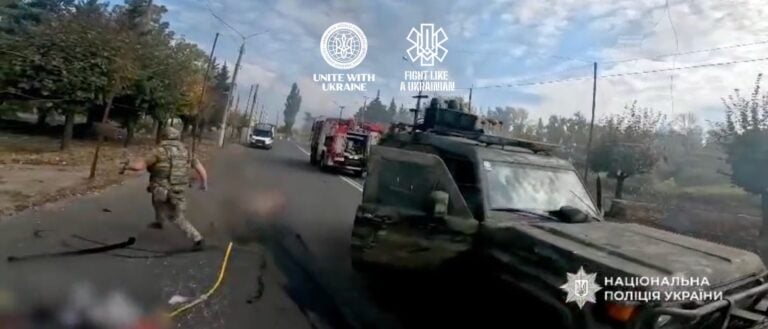
UWC funded armored ambulances evacuate wounded after deadly Russian attack on Kramatorsk
 #LocalAction