



 Lubomyr Luciuk, Professor Emeritus of The Royal Military College of Canada, a Senior Research Fellow with the Chair of Ukrainian Studies at the University of Toronto
The Atlanta Hotel was an ordinary place — a respectable setting for a meeting.
Colonel Yevhen Konovalets had some doubts about the man he was meeting, but went anyway. His commitment to Ukraine outweighed concerns for personal safety. He would not turn away from any opportunity to help his embattled nation.
23 May 1938 was a Monday — a bright spring day in Rotterdam. Just before lunch, Konovalets took a seat in the café at a table near a window overlooking the street. He was 46. He asked for a sherry. The younger man who joined him — 30 years old — ordered a beer. They spoke for only a few minutes. Before leaving, the visitor gave him a gift: a box of chocolates. Konovalets liked chocolate.
Within minutes, Konovalets lay dead — assassinated by an NKVD agent acting on Stalin’s orders. The bomb hidden in those bonbons was meant not only to kill a man, but to decapitate the Ukrainian nationalist movement. Yet the Soviets failed. Colonel Konovalets’s name endured.
I first learned about him when I was a young boy. A large photograph of him adorned Kingston’s Ukrainian hall on Bagot Street, a place where our community gathered to remember its history and heroes. I spied that very same image again and again in Ukrainian cultural centres across North America and Western Europe. For most of my early years, I did not fully understand who he was or why he might be worthy of such honour.
For my parents, like many who devoted their lives to the cause of Ukrainian independence, Konovalets represented a generation who refused to accept that Ukraine’s struggle for independence was over. He believed Ukraine would one day be free. So did they. They were proven right.
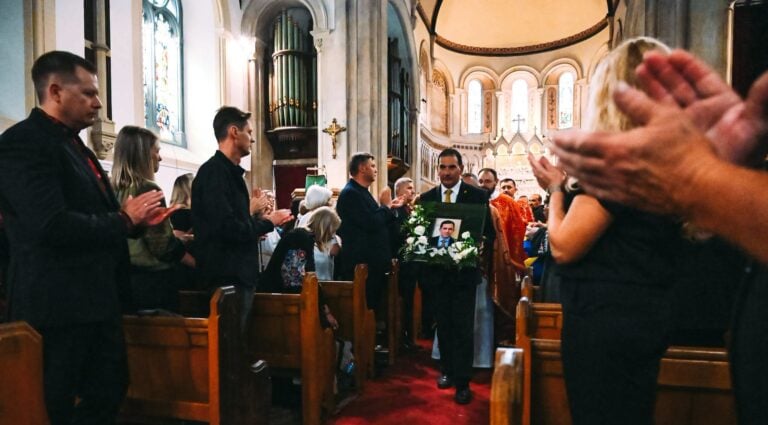
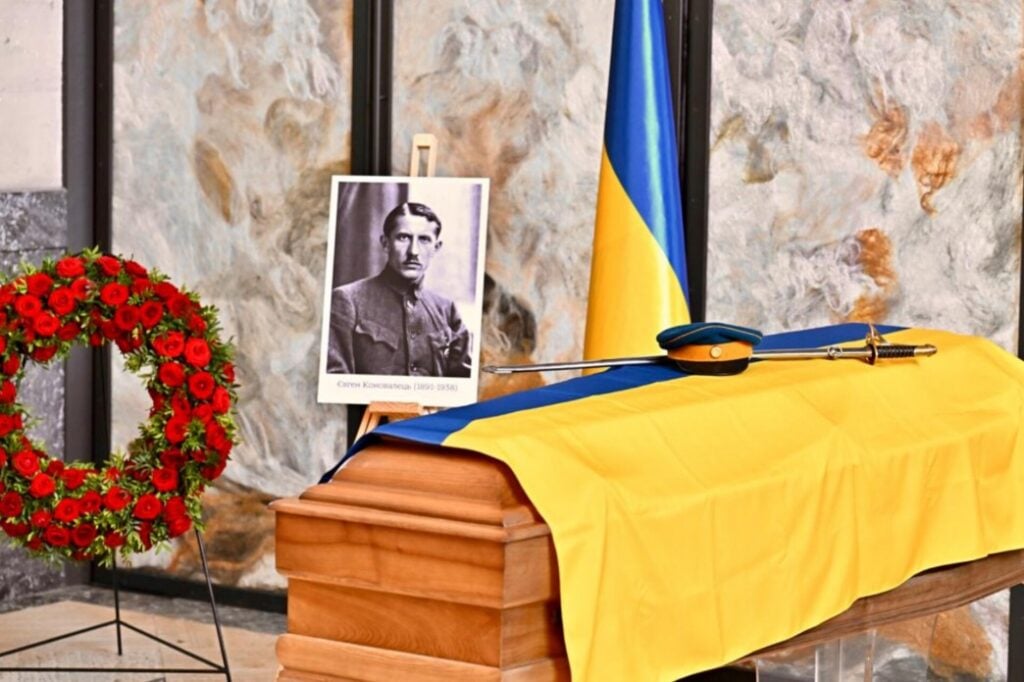
Now, almost nine decades after his murder, I am sitting in the Atlanta Hotel café, a sherry to hand. Not far from here, Colonel Konovalets’s remains were exhumed at Crooswijk Cemetery — the latest step in his long odyssey to Ukraine, where he will be laid to rest at a military burial ground outside Kyiv. I will not accompany him. I chose instead to remain here, where his life was ended.
As an honour guard accompanies him across Europe, a rare solar eclipse will be visible over much of the continent — the Moon passing partly across the face of the Sun, dimming its light without ever fully extinguishing it. It is a strange coincidence, mirroring the story of Ukraine itself. For more than a century, that nation’s flame has been dimmed time and again — through conquest, famine, terror, occupation, and war — yet it has never gone out. Millions endured decades when freedom seemed beyond reach, and remembering became an act of resistance.
Following the revolutionary years of 1917–1921, after Ukrainian statehood was extinguished, many believed this cause forlorn. Its leaders were scattered across the diaspora — imprisoned, hunted, and often killed. But Konovalets refused to accept defeat. Through the Ukrainian Military Organization, and later as the first leader of the Organization of Ukrainian Nationalists, he continued the struggle in exile.
Moscow feared what Konovalets represented. His assassination was part of a wider campaign to suppress Ukrainian resistance. He would not be the only prey. Even after the collapse of the USSR, efforts to silence Ukrainian leaders continued — including the poisoning of President Viktor Yushchenko in 2004. President Volodymyr Zelensky remains a target, as Russia wages a genocidal war against the Ukrainian nation.
The parallel between the Colonel’s time and ours is difficult to ignore. That is why bringing him home matters. This is about more than comrades-in-arms honouring a fallen soldier. His return restores a connection across generations — between those who took up arms then and those who fight now, despite overwhelming odds, against those who would deny Ukraine its right to exist.
In Rotterdam, as I think of a brave leader torn away from Ukraine, and of an ideal that could not be liquidated, I also remember what his widow, Olha, said as she grieved by his grave:
“This is for Ukraine…”
Four simple words. They echoed for she foresaw how her husband’s tomb was only temporary — hallowed ground where he would wait until his people came to carry him back to the soil of a free Ukraine. That day has come.
Ukraine’s son has gone home. His limbo is over.
And that is for Ukraine.
Cover: president.gov.ua
Latest news
 #GlobalAdvocacy
Russia seizes foreign businesses: Turning Kremlin blackmail into advocacy tool
 #LocalAction