



by Zenon Kowal, a member of the UWC Executive Committee, political adviser to the European Congress of Ukrainians and the Association of Ukrainians in Belgium, as well as former Special Adviser to the Embassy of Ukraine in Belgium (1992-1995)
The process of creating a National Pantheon in Ukraine and reburying prominent figures of the last century who found their final resting place in exile is far more than a technical transfer of human remains. It is a profound, sensitive political and historical undertaking.
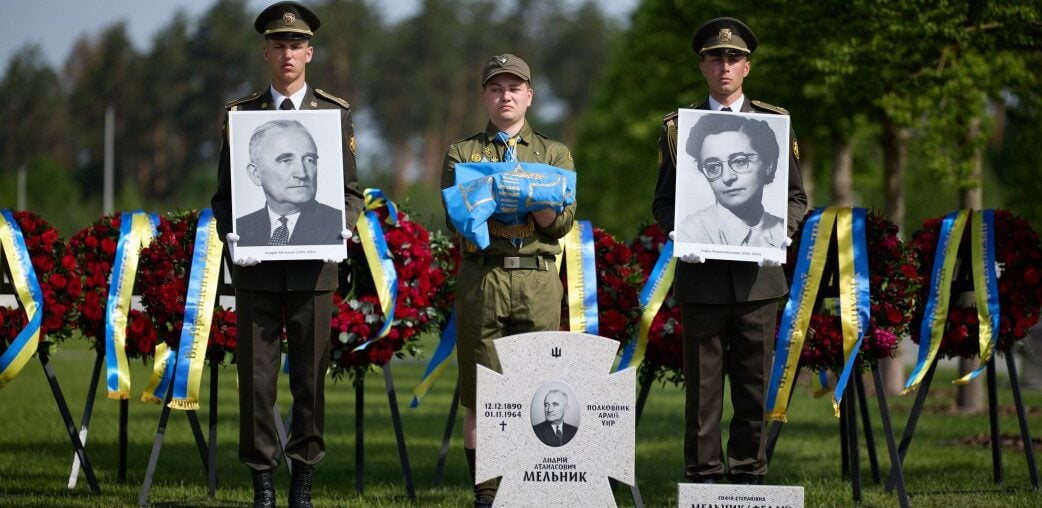
The recent reburial of OUN leader Andriy Melnyk and his wife Sofiia from Luxembourg, along with the announced return of Yevhen Konovalets’ remains, clearly demonstrates that Ukraine is reclaiming its historical continuity. Once again, we are proving that our statehood did not emerge “yesterday” or “thanks to Lenin,” as Putin’s disinformation narratives claim, but is the result of centuries of collective struggle by the Ukrainian people.
At the same time, this process has exposed a number of challenges in communication between the Ukrainian state and Ukrainians worldwide.
Melnyk’s reburial sparked debate. Part of the Ukrainian community criticized the state for making the decision without their direct involvement. Their concerns were understandable: Ukrainians abroad had spent decades caring for the grave through their own efforts, resources, and dedication.
In such sensitive matters, the state must act with the utmost tact and use its diplomatic missions to initiate contact with leading community organizations on the ground.
This is simply the normal, respectful way to engage and communicate with communities that have devoted decades to preserving these sites. Embassies should determine who has been responsible for maintaining a burial site and engage in genuine dialogue rather than operating on the principle of a directive: “We were told to take it, so we took it.” What is needed is a normal, human, courteous conversation.
The Melnyk case should serve as a lesson for state institutions to avoid repeating similar missteps in the future, especially since additional reburials lie ahead.
To understand the community’s concerns, it is important to look at the historical context. The wave of Ukrainian émigrés who arrived in the West after World War II initially lived quite literally “out of their suitcases.” They sincerely believed that the struggle would continue, that Soviet occupation could be overcome, and that they would eventually return home. When it became clear that this would not happen, they began building strong Ukrainian communities abroad with one overriding goal: preserving a Ukrainian identity that was being relentlessly suppressed and Russified in Soviet Ukraine. They raised their children in the Ukrainian tradition, spoke Ukrainian, and remained deeply connected to Ukraine.
The graves of émigré leaders such as Symon Petliura, Andriy Melnyk, Stepan Bandera, and Yevhen Konovalets became focal points for these communities. People gathered there on significant anniversaries, and these sites helped preserve a living memory of the Ukrainian People’s Republic and the struggle for independence. For Ukrainians abroad, these burial sites are far more than cemeteries. They are symbols of their own decades-long effort to preserve Ukraine beyond its borders.
The transfer of remains to Ukraine does not mean that burial sites abroad should be removed or forgotten.
If we speak, for example, about Symon Petliura, his gravesite in Paris should unquestionably remain where it is. The Ukrainian state should ensure that the site is secured and properly maintained. After all, it is a historic place of memory: Paris is where the Chief Otaman lived, where he was assassinated, and where he rested for decades. The Paris gravesite can clearly indicate that his remains have since been reinterred in Kyiv, but the monument itself should remain as a historical marker for Ukrainians in France and across Europe. Our historical footprints on the world map should not disappear.
Can the process of reburials become a new bridge between Ukraine and Ukrainians worldwide? Absolutely. But that bridge must rest on several key principles:
- Respect for the wishes of the individual and their family. If there is an official will in which a person clearly stated their desire to have their remains returned to a united Ukraine, the matter is straightforward: that wish should be honored. If family members or descendants hold a different view, the state has an obligation to respect their position.
- Consensus when no will exists. In the case of Andriy Melnyk, no written instructions survived, although his life in exile strongly reflected his desire to see Ukraine free. When there are no relatives, the only legitimate partner for the state in such discussions becomes the community that maintained and financed the burial site, often handling complex administrative and technical matters, including cemetery leases in European cities.
- Recognition of the community’s contribution. At the state level, Ukraine should clearly express its gratitude to Ukrainian communities abroad for ensuring that the memory of these leaders survived despite decades of Soviet repression.
The process of building a Pantheon in Kyiv is not about the state appropriating history. It is about restoring historical justice together. When the Ukrainian state openly and respectfully acknowledges the role of diaspora communities in preserving national memory, and when those communities feel like full partners in shaping this new policy of remembrance, the return of Ukraine’s heroes home will truly unite Ukrainians on both sides of the border.
Cover: Office of the President of Ukraine