

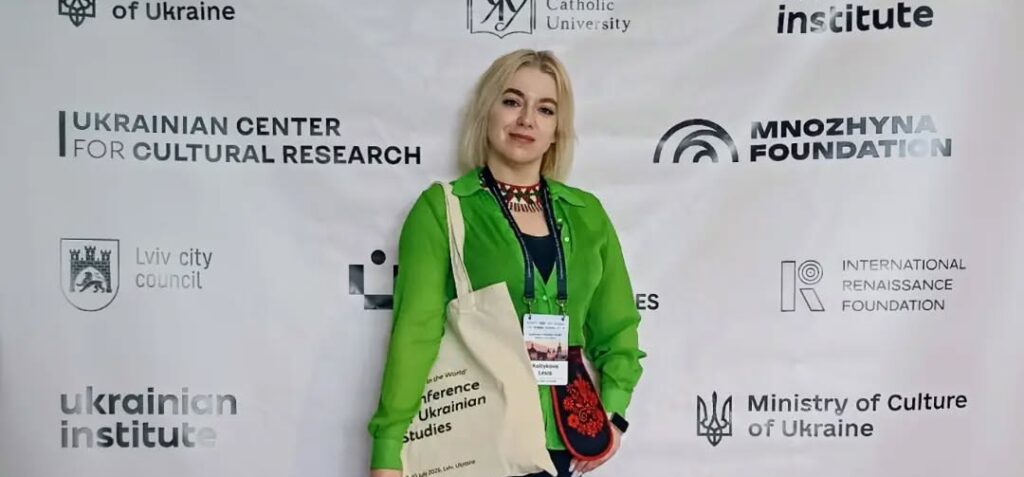


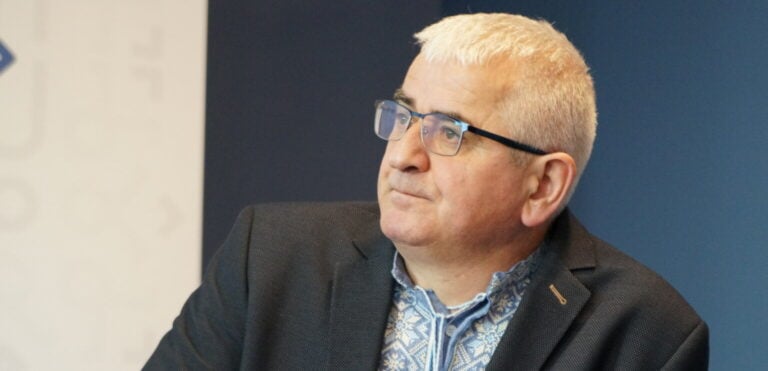
This is a transcript of an address by Lesia Koltykova, communications specialist and co-founder of Casa de Ucrania (Ukrainian House) in Mexico, at the Conference of Ukrainian Studies: Ukraine in the World, held at the Ukrainian Catholic University (UCU) in Lviv.
Dear colleagues, dear friends,
Thank you for having me in this block on Transnational Ukrainian Networks. It is a special feeling to speak to people who do not need to be persuaded of anything – everyone in this room already carries a piece of Ukraine in their daily work. So today I would like to talk with you about a method: how we can systematize our communication practices abroad, especially in countries where Russian propaganda has been cultivating the soil for a very long time.
Let me begin with two small stories.
In 2015, after the terrorist attack on Charlie Hebdo, the whole world stood up with three words: “Je suis Charlie.” That phrase was created by a Frenchman of Ukrainian descent – Joachim Roncin. In 2019, when Notre Dame was burning, people in Ecuador – most of whom had never been to France and do not speak French – followed the news with real sorrow, as if it were their own loss.
And now the third story, the one that hurts. In September 2025, in that same Ecuador, at an international film festival, a screening of a Ukrainian documentary about our war gathered an audience of five people.
Five. In the twelfth year of the bloodiest European war since 1945.
The soil we are working with
Why does this happen? I do not believe it is a failure of our message, and it is certainly not a failure of our people. It is a question of soil.
The world – especially across the ocean – knows very little about Ukraine, and what it knows has been filtered through more than a century of Russian propaganda, working systematically and deliberately. The grandparents of today’s audiences were already charmed by the “greatness of Russian culture” and by those Potemkin facades that Russia, in all of its state forms, has tirelessly presented to the world.
One quiet example. More than a third of the repertoire of Mexico’s leading symphony orchestra consists of so-called Russian composers – far more than Italian or German ones. This is not an accident of taste. This is infrastructure.
In Latin America the picture is even more layered. For the far left, Russia is the antagonist of the United States, a counterweight to American imperialism. For the far right, Russia is “the last stronghold of traditional values.” Both images are inaccurate – and both are deeply rooted, while Ukraine was simply absent from public discourse for decades. Our Ministry of Foreign Affairs adopted its first strategy for Latin America and the Caribbean only in 2024, after the full-scale invasion.
In such soil, direct promotion of Ukrainian narratives often does not grow. A person raised on stories of Russia’s magnificent civilization will feel little when they see a protest, a call for Russia’s dissolution, or even an appeal to international law. Empathy does not come from information alone. Empathy grows from familiarity – from the feeling that a culture belongs to the shared story of civilization. That is why Ecuadorians grieved for Notre Dame and did not come to our film.
But here is the good news: we do not need a hundred years to change this discourse. Globalization and the internet give us a chance to shape Ukraine’s image here and now – if we study the cultural soil carefully and plant with sensitivity.
A three-step model
From practical experience – much of it in Latin America, but applicable far beyond – I would like to offer you a simple, systematized model. Three steps.
- Step one: begin with what is already theirs
The first step sounds almost paradoxical: do not begin with Ukraine. Begin with the country you are standing in.
Ukrainians have done a great deal for humanity, not only inside Ukraine but all over the world. So we start with achievements that local people already, and quite rightly, consider their own. The producers of the finest yerba mate in Argentina. Brilliant hockey stars in Canada. Leading engineers at IBM and NASA – everything America is traditionally proud of. And behind all of it stand Ukrainian names and surnames.
When you tell such stories in a host country, something gentle and important happens: there is no rejection, no defensive reflex. You have not asked your listener to adopt a new loyalty. You have shown them that Ukraine was quietly woven into their own pride all along. The door opens by itself.
This step requires homework. It cannot be done from a template – each region needs careful study and its own entry point.
- Step two: reveal the true scale of our culture
Once emotional contact exists, we take the second step: we speak about events that happened in Ukraine and changed the face of modern civilization.
And here we must be tender but honest with ourselves. Embroidery, Easter eggs, wreaths, folk songs and dances – these are treasures, and they touch the heart. But imagine a person whose very first meeting with Ukraine consists only of folklore and agrarian craft. What they receive is a fragmentary representation of our culture – one beautiful room of an enormous house. And fragmentary representation is exactly what our enemy needs: they frame these fragments as all that we have, as the whole of us – a “young nation,” a secondary culture next to “great” Russia.
So we widen the lens – always choosing themes for the specific audience.
For students and scientists: one of Europe’s first constitutions; early nuclear research; pioneering organ transplantation; the creation of programming languages, helicopters, and rockets; the decoding of the Mayan alphabet.
For creative audiences: our national opera and symphonic traditions, opera theaters of full European standard that appeared before similar institutions in our northern neighbor, and the avant-garde artists who shaped the twentieth century.
For historians, museologists, and theologians: connections with Ukrainian experts, architectural and urbanist traditions, and ancient cultures such as Trypillia and Yamna.
For municipal and civic audiences: the fact that Ukrainian cities held Magdeburg rights five to ten times more often than Russian cities – living evidence of deep institutional traditions of self-governance.
And the model travels. In Northern Europe, imagine a multimedia installation placing Ukrainian dumas beside Karelian runes – manuscripts, the kobza next to the kantele – and drawing the line of generational continuity: Karelians who fought for Finland’s independence, preserved the values of freedom, and passed them on. In Ukraine today, a living example of such inherited values is Denys “Redis” Prokopenko, great-grandson of Karelian warriors and commander of the Azov Corps.
In countries with strong monarchic traditions, one can explain that Ukraine’s flag is not simply “sky and wheat,” but carries the golden lion on blue of the Galician-Volhynian principality – and propose an exhibition within a heraldic society. Such details open doors to institutions.
The purpose of this step is precise. We want our listener to pause and feel a productive contradiction: the real scale of Ukrainian culture does not match its representation in the information space. “Why have I never heard this before?” When that question is born inside the listener, Ukraine acquires subjectivity in their eyes and takes its place among the historic nations of Europe, with their statehood and the antiquity of their institutions. From that position, conversations about the war arise naturally – often begun by our interlocutors themselves.
- Step three: the manner is the message
The third step is about how we speak – and for me, it is the heart of everything.
Despite the deep trauma of this war, we must avoid a hysterical register, and we must avoid direct denigration of the enemy’s culture. Abroad, especially in distant regions, such communication is maximally ineffective – and its consequences are skillfully harvested by the enemy. Moscow tirelessly repeats that Ukrainians are “organically incapable” of statehood, aggressive and unstable – unlike their own “restrained and dignified” selves. Every time we shout, we hand them their favorite illustration.
But let us be clear about what that “great culture” of theirs really is. It is a bright facade – and however bright a facade may be, it can be pierced with one finger. Behind it there is no living substance, because an authoritarian system cannot produce talented improvisers; its people act only formally, by script, by template. Our strength is the opposite. We carry our narratives in living contact with living people. We build sincere relationships. Our genuine respect and honest curiosity toward another culture win hearts – and this the enemy can never imitate, because it contradicts the very nature of a closed society.
There is a name for this. The Ukrainian writer Lyubko Deresh calls it gentle power – лагідна сила. Not soft power, which is a category of state resources, but gentle power: the capacity to serve, to give of oneself for the common good, to listen with empathy, to stand on truth and justice without moral blackmail. Deresh reminds us that Ukraine demonstrated this power to the world in the darkest days of the full-scale invasion – and that it is a capital we must not squander. Gentle power is not weakness. It is a moral position. Warmth as strategy. Kindness as precision. It is not a compromise of our stance – it is our sharpest instrument.
Our everyday ambassadors
Before I close, a word about the people who carry this work every single day: our diaspora.
These are people living their natural lives who, out of pure care and conviction, found themselves in a completely new role – representing an entire country. Without preparation, and in the conditions of emigration, which is already an enormous challenge in itself. They organize, they teach, they explain, they stand at podiums after full working days. They are everyday heroes, and they deserve our deepest admiration.
Our duty – and truly, our joy – is to equip them. We must create informational blocks: well-researched, regionally adapted materials that help present Ukraine more broadly and more fully, tuned to the particularities of each region. Not because their work is lacking – but because their dedication deserves the best instruments we can place in their hands. When a volunteer in Buenos Aires or Toronto has the local stories, the civilizational facts, and the right tone at her fingertips, her natural sincerity multiplies tenfold. This is exactly what transnational Ukrainian networks are for.
In closing
Institutions outlast personalities. Our cultural initiatives abroad must be long-term, networked, and united by a broad vision. We do not need a century to change the discourse. We need three things: first contact done with care; the quiet revelation of Ukraine’s true scale; and a gentleness of manner that no authoritarian facade can counterfeit.
Lead with what is theirs. Reveal what is ours. And speak as free people speak – softly, with respect, with curiosity, and without fear.
Thank you.
Cover: Lesia Koltykova on Facebook
Latest news
 #LocalAction
Kyiv, Warsaw, and Russian threat: How Ukrainians in Poland preserve dialogue
 #CallToAction